

TL;DR: Agentic commerce is the shift from people browsing your website to AI systems helping them discover, compare, and sometimes buy products. Discovery is already widespread: assistants can recommend products and send high-intent shoppers to merchants in Greece and elsewhere. Agent-initiated checkout is developing through commerce protocols, platforms, payment providers, and card networks, but broad availability remains limited and varies by market. For merchants, the immediate priority is accurate product data and a machine-readable catalogue. Payment and checkout integrations should follow the platforms and providers that their customers actually use. This article explains what is live, how the main standards differ, what European and Greek merchants should verify, and how Advisable can help them prepare.
A practical guide to the checkout layer of AI shopping for e-commerce founders, marketers, and operators
Your next customer might not have a heartbeat
For most of the history of online shopping, the pattern was the same. A person searched, clicked through to a store, looked at the photos, read a few reviews, added something to a cart, and typed in their card details. Everything about a modern e-commerce site, from the hero banner to the persuasive product copy, was built to convince that human to click buy. Agentic commerce changes who you are actually selling to, because the first thing that evaluates your store may now be a piece of software acting on a shopper''s behalf.
The idea is simple to picture. A customer opens an AI assistant and says something like, find me waterproof hiking boots under one hundred and fifty euros that can arrive by Friday. The agent reads that request, looks across multiple stores, weighs the options against the stated criteria, and hands back a short answer or completes the order outright. The shopper never scrolls through your carefully designed homepage, and the agent never sees your branding. It reads structured data such as your price, your stock levels, your delivery estimate, your specifications, and your return policy, and it decides in a fraction of a second whether you belong on the shortlist.
This matters because the volume of shopping that starts inside AI assistants has grown faster than almost anyone predicted. Traffic from AI tools to retail sites climbed several hundred percent year on year through early 2026, and the visitors who arrive from an AI recommendation tend to convert far better than visitors from social feeds or generic search, because the agent has already done the filtering (as summarised in industry reporting here). The opportunity, and the risk, is that this new front door concentrates demand on a handful of products per query rather than a long list of links. If your data is messy or incomplete, the agent quietly skips you and recommends a competitor, and you never even see the lost sale.
Discovery and checkout are two different things
The single most useful distinction in this whole topic is the one that separates being found from being bought. Merchants who have started experimenting with agentic commerce keep arriving at the same two buckets, and holding them apart clears up most of the confusion around what is real today and what is still early.
The first bucket is discovery. This is your products appearing inside an AI conversation when someone asks for a recommendation. It is already happening at scale, largely because the major assistants crawl the open web and read the same product feeds that power search and shopping ads. For practical purposes, your catalogue is likely already being surfaced by these models whether you have opted in or not, which means the real question is not whether you appear, but whether you appear well enough to be selected.
The second bucket is checkout. This is the agent completing the purchase, taking payment and placing the order, sometimes without the shopper ever leaving the chat window. This is the part that is genuinely new, and it is also the part that has moved more slowly than the headlines suggested. The technology to make it work is now in place through a small set of open standards and payment tokens, but the availability of true in chat checkout depends heavily on where your business and your customers are based.
How agentic checkout actually works under the hood
You do not need to be an engineer to understand the main standards, but it is important not to treat them as one mandatory stack. ACP and UCP cover overlapping commerce workflows and may serve as alternative integration paths. AP2 focuses on payment authorisation, while Visa and Mastercard provide network-level identity, tokenisation, and trust capabilities.
| Framework | Primary role | How it fits |
|---|---|---|
| ACP | OpenAI and Stripe protocol for agent-to-merchant checkout, including order and payment-data exchange. | A commerce protocol used by ACP-based surfaces. It can be an alternative to UCP rather than a required layer beneath it. |
| UCP | Google-led protocol covering product discovery, cart creation, checkout, order management, and post-purchase workflows. | A broad commerce protocol for compatible surfaces. It is not limited to discovery and includes built-in support for AP2. |
| AP2 | Google-led payments protocol that uses cryptographic mandates to record user intent and payment authorisation. | A payment authorisation and trust layer that can work with UCP and other commerce systems. |
| Visa | Visa Intelligent Commerce and the Trusted Agent Protocol provide tokenised credentials, controls, and agent identity signals. | A card-network trust and payment layer, not a replacement for a merchant checkout protocol. |
| Mastercard | Mastercard Agent Pay combines tokenisation, authentication, consumer consent, and agent verification. | A card-network programme that supports agent-initiated payments alongside merchant and platform integrations. |
A merchant will usually support the commerce protocol required by the AI surface or platform it wants to reach, then use the payment capabilities offered by its processor and card networks. UCP can manage the full journey on compatible surfaces, including discovery, carts, checkout, and order management. ACP supports checkout on ACP-based surfaces. AP2 and the network programmes can supply authorisation and trust, depending on the payment flow. The exact combination varies by platform, processor, and region.
Tokenisation is one of the main safeguards across these systems. Instead of exposing a customer''s card number to an AI agent, the payment flow can use a credential restricted by merchant, amount, purpose, or time. The merchant or payment processor validates and charges that credential through the agreed checkout flow. In the merchant-centred models described by ACP and UCP, the merchant remains the merchant of record and continues to manage fulfilment, taxes, returns, and customer support.
OpenAI launched Instant Checkout in ChatGPT in September 2025, initially for purchases from US Etsy sellers, with a wider Shopify expansion announced. OpenAI discontinued the original Instant Checkout experience in March 2026 after adoption and performance remained limited, according to Forrester. OpenAI''s commerce activity then shifted toward product discovery and ChatGPT apps, where many merchants direct shoppers to their own sites to complete payment. The practical lesson is to prepare product data and merchant-hosted checkout without assuming that native in-chat purchasing will be the dominant route.
Where this stands in Europe and Greece
Availability is the part most guides get wrong, because so much of the coverage is written from a United States point of view. The reality on the ground is more nuanced, and for a Greek or wider European business the distinction between discovery and checkout becomes very practical.
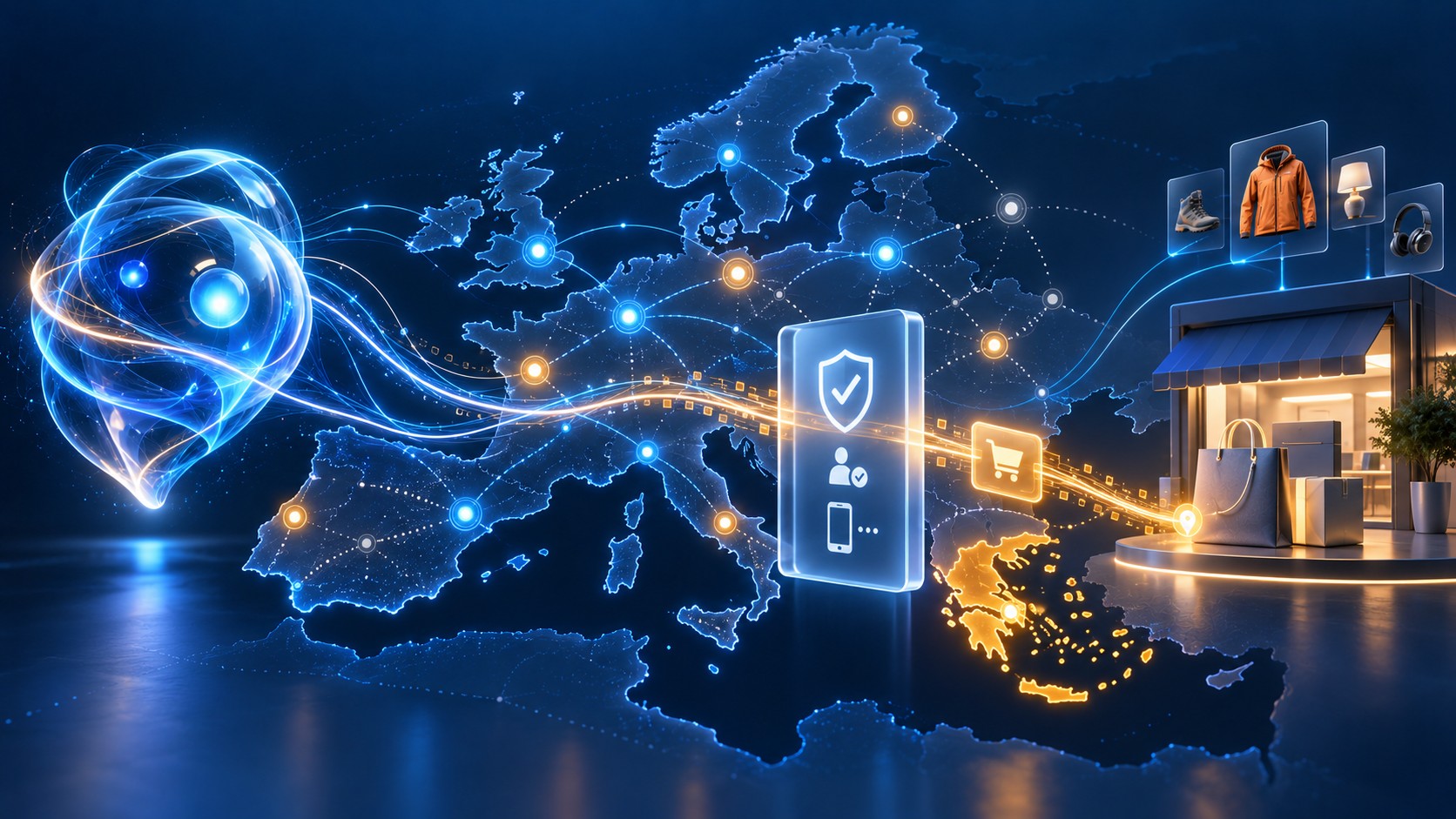
Discovery is already reaching European stores. AI assistants can recommend products and refer shoppers to European merchants today. Native in-chat checkout is much less predictable: features, partnerships, and regional access have changed quickly, including the discontinuation of OpenAI''s original Instant Checkout experience. European merchants should verify availability for each AI surface, commerce platform, payment processor, and country rather than relying on a global launch announcement.
The card networks have moved agent-payment technology forward in Europe through network enablement and controlled pilots. In June 2026, Mastercard said all of its European issuers were enabled at a network level for Agent Pay and listed more than thirty banks that had completed controlled live transactions using passkeys. Mastercard also described a separate end-to-end European transaction with Worldline and ING. These are meaningful readiness signals, but they are controlled implementations rather than evidence that agent-initiated checkout is broadly available to European merchants.
There is one genuinely European complication worth understanding, which is that agent payments run straight into the Strong Customer Authentication rules under PSD2. Those rules assume a human supplies two independent factors, such as a password and a fingerprint or a device tap, and an agent buying without a person present at the moment of sale does not fit that assumption neatly. There is no special exemption for agents, so the emerging approach relies on scoped tokens that carry proof the shopper already completed authentication, together with auditable records of exactly what they consented to. Until that settles into common practice, agent checkout in the European Union is as much a compliance question as a product one.
For Greece, the position requires the same distinction. Mastercard''s June 2026 list includes Eurobank Greece and the National Bank of Greece among institutions involved in controlled transactions. That shows issuer-side participation, but it does not mean that Greek merchants can broadly enable agent-initiated checkout through every local payment provider. Merchants should ask their acquirer, processor, and commerce platform which agent-payment capabilities are commercially available and how Strong Customer Authentication is handled. In the meantime, improving product data and feeds remains useful regardless of the payment timeline.
How to get your store ready, step by step
The encouraging part is that the work you do to prepare pays off immediately through better performance in AI recommendations, regardless of when full agent checkout lands in your market. Here is the practical sequence we walk merchants through, ordered so that the highest impact work comes first.
- Clean up your product data first, because this is what agents actually read. Give every product a complete, unambiguous title in the pattern of brand, type, and key differentiator, along with accurate live pricing, real time stock levels, proper identifiers such as GTINs where they apply, clear specifications, and high quality images. Agents penalise ambiguity far harder than human shoppers do, so a vague or incomplete listing (see this Shopify merchant discussion) is often the real reason a competitor gets chosen instead of you.
- Make your product feed structured and machine readable. Agents compare structured data across many merchants in milliseconds, so a store with an excellent internal catalogue but a poor protocol ready feed will still lose to a simpler store with a clean one. Structured data and clear fulfilment terms are now part of what determines whether you are selected at all.
- Publish the discovery handshake. Expose the standard discovery profile that lets compliant agents see your capabilities and endpoints. On managed platforms such as Shopify this is largely handled for you through their agentic storefront features, while custom stores publish the manifest themselves. Without this step, agents that speak the protocols cannot properly negotiate with your store.
- Implement checkout session endpoints. Support the create, update, complete, and cancel steps that let an agent build and confirm an order, including discount handling if you run promotions. This is where your store moves from merely visible to genuinely buyable.
- Choose a payment path that is ready for agents. Confirm that your payment processor supports the network agent frameworks, or plan a move toward a provider or platform that does. This is the step most tied to your region, and for European merchants it is where the Strong Customer Authentication questions need to be handled properly.
- Track agent driven orders as their own channel. Set up clean attribution so you can separate AI referred sessions and orders from everything else, using your platform''s channel reports and consistent tagging. Without a baseline you cannot tell what is working, and the early data is genuinely valuable for tuning everything above it.
Two of these steps, cleaning your data and structuring your feed, deliver value the moment they are done, because they improve how often agents recommend you long before anyone checks out in a chat window. The later steps position you to switch on agent checkout the day it becomes available through your provider, rather than scrambling to catch up once your competitors are already there.
A note on cost and what is worth the effort
Where in chat checkout has been available, the platforms have charged differently, and it is useful to know the shape of it. The assistant led checkout inside ChatGPT carried a platform fee on completed orders on top of normal payment processing, while checkout through Google and Microsoft surfaces has carried no additional platform fee so far (as reported by PYMNTS). Since the shift toward merchant hosted checkout, product discovery itself carries no platform fee, which means the main cost of getting ready is the effort of improving your data and feed rather than a toll on every sale.
The way to think about any fee is in the context of quality rather than headline percentage, because a small charge on a channel that converts substantially better than cold traffic is a very different decision from the same charge on visitors who were never likely to buy. For most stores the honest near term prize is not in chat checkout volume today, it is being the store that agents consistently select and send high intent shoppers to, which is entirely within your control right now.
How Advisable can help
Advisable sits exactly where this shift needs support, combining hands on e-commerce work with the technical and AI expertise to make a store genuinely agent ready. Rather than waiting for agent checkout to arrive and reacting late, we help Greek and wider European merchants build the head start that the current window makes possible.
- Agent readiness audits. We review how your products currently appear to AI agents, identify why you are or are not being recommended, and give you a prioritised list of what to fix first.
- Product data and feed engineering. We clean, structure, and enrich your catalogue so agents can read and rank it correctly, which is the single highest impact investment you can make today.
- Technical implementation. We publish your discovery profile, implement the checkout session endpoints, and connect the protocols so your store moves from visible to buyable.
- Payment and compliance guidance. We help you choose a payment path that will support agent checkout as it reaches Europe, with the Strong Customer Authentication and consent requirements handled correctly from the start.
- Measurement and strategy. We set up clean attribution for AI driven orders and help you read the early signals, so your agentic commerce strategy is guided by your own data rather than by hype.
If you want to understand where your store stands today and what it would take to be selected by AI agents before your competitors are, this is the right moment to start, and Advisable can take you from a first assessment through to a store that is ready for the next era of shopping.
Resources
- Agentic Commerce Protocol official documentation, OpenAI and Stripe
- Buy it in ChatGPT: Instant Checkout and the Agentic Commerce Protocol, OpenAI
- Universal Commerce Protocol official documentation
- Under the Hood: Universal Commerce Protocol, Google Developers Blog
- Announcing Agent Payments Protocol, Google Cloud
- Agentic Payments in B2C Commerce: Where We Are Now, Forrester
- The State of Agentic Commerce in Mid-2026, Forrester
- Visa Intelligent Commerce and Trusted Agent Protocol
- Europe is Building the Foundations for Trusted Agentic Commerce, Mastercard
- Agentic Payments: a New Challenge for Europe''s Payments Ecosystem, Osborne Clarke
- Millions of Merchants Can Sell in AI Chats, Shopify
- ChatGPT Commerce and Agentic Shopping Statistics 2026, Elogic
- The Universal Commerce Protocol: How European Commerce Leaders Should Respond, Merkle