
The conversation is no longer whether AI will change ad production. It already has. The real question, the one this article is written to answer, is where it is genuinely replacing traditional workflows, where it is complementing them, and where deploying it has already backfired in very public, very expensive ways.
The Shift Nobody Can Ignore
If you work in advertising, marketing, or brand strategy, you already feel it. The briefs arriving with Midjourney visuals attached. The client asking why the quote for a product video is four times what an AI tool charges. The creative director who produced 70,000 video clips in 30 days with a team of five.
This is both sides of the coin.
The Scale of What Is Happening
Let's start with the numbers, because they frame everything else.
The AI marketing industry has grown from $12.05 billion in 2020 to $47.32 billion in 2025, a 293% increase in five years. The global generative AI market alone is valued at $62.75 billion in 2025 and is projected to reach $356.05 billion by 2030. These are not niche figures. This is a restructuring of the entire marketing technology stack.
At the practitioner level, adoption is near-total. According to recent industry data, 88% of marketers now use AI daily. Nearly 90% of marketers have integrated AI into their processes in some form. The AI in the marketing sector is expected to grow at a compound annual growth rate of 26.7% between now and 2034, reaching $217.33 billion.
The specific application driving the most change right now? Ad creative production.
According to IAB's 2025 Digital Video Ad Spend & Strategy Report, generative AI is now a cornerstone for video ad creation, with 86% of buyers using or planning to use it to build video ad creative. Advertisers are most likely to use AI for ads in social media (85%) or display (73%), while 56% use it for TV ads and 42% for audio ads.
That is not an emerging trend. That is the current state of the industry.
What AI Creative Production Actually Delivers
Before examining where AI creative falls short, it is worth being precise about what it genuinely delivers, because the performance data in certain contexts is remarkable.
Speed
AI video tools reduce production timelines from weeks to hours. Industry data shows AI video tools can slash time-to-market from 3 weeks to 24 hours, an 84% reduction in turnaround time. For brands running performance marketing at scale, where creative refresh cycles are measured in days rather than months, this is transformative.
Cost
AI video tools reduce production costs by 80%. Traditional production involves paying repeatedly for crews, studios, editing, and talent every time new creative is required. AI flips that model: the fixed investment is in tools and expertise, not in per-asset production overhead.
Volume and variation
With automated systems, marketers can experiment with numerous creative variations at once, varying hooks, visuals, and messages. Conventional workflows tend to generate a limited number of ad versions due to the time and money involved in developing each variation. More testing directly correlates with better-performing ads. The brands seeing the most improvement are those treating AI as a variation engine rather than a replacement for creative strategy.
Personalisation at scale
92% of businesses now use AI for campaign personalisation — not just switching first names in emails, but personalised pricing, dynamic visuals, and tailored product suggestions based on browsing behaviour. This level of personalisation was previously only accessible to large enterprises with substantial data infrastructure. AI has democratised it.
ROI
McKinsey reports that companies using AI in sales and marketing see 10–20% higher ROI. Ad campaigns with automated optimisation show a 30% better CPA compared to traditional methods.
The Sectors Where AI Creative Is Genuinely Replacing Traditional Production
Not all sectors are equal here. The replacement is most advanced and most defensible in specific contexts.
Performance Marketing and E-Commerce
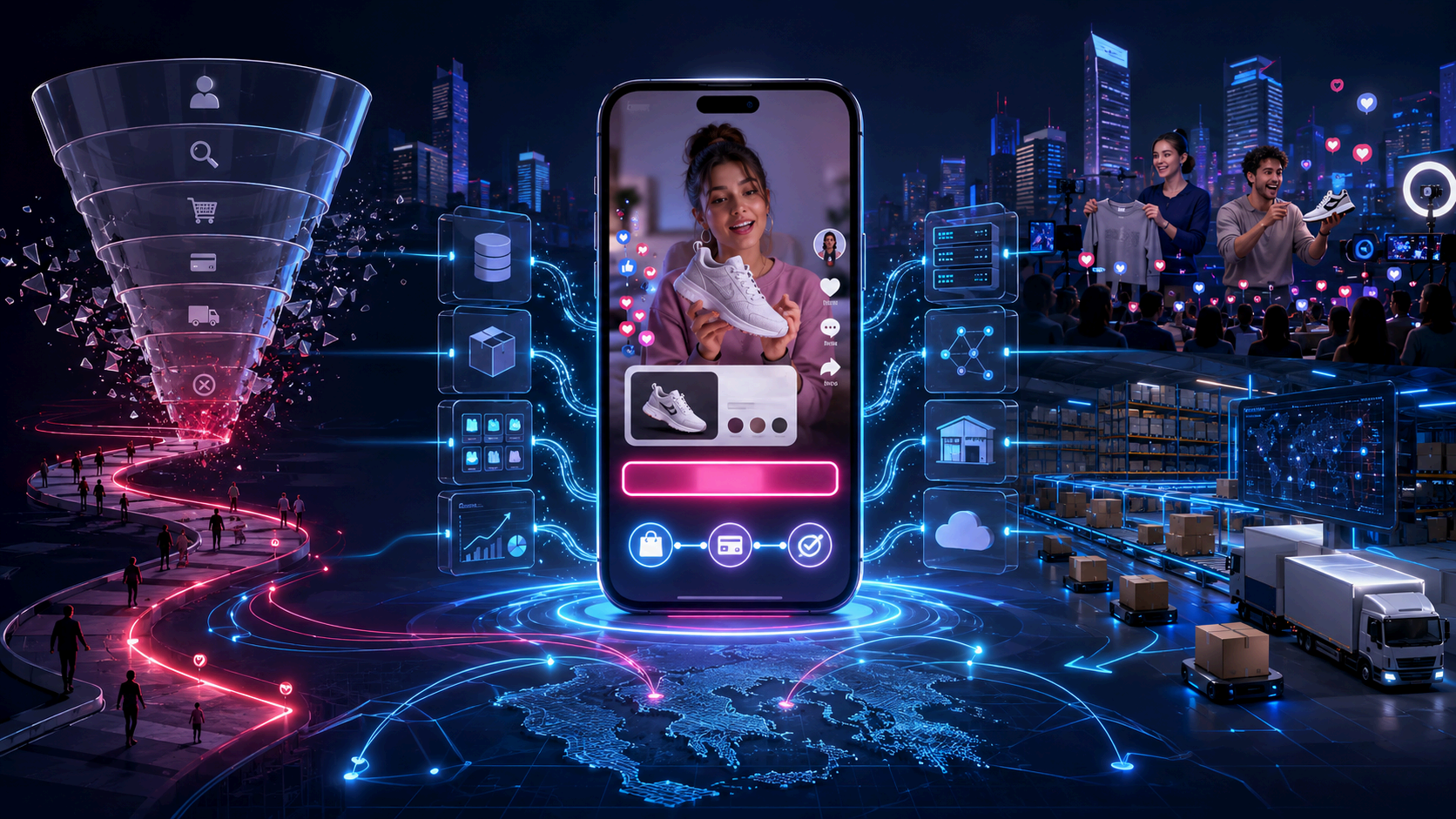
This is where AI creative has the strongest case. E-commerce brands running paid social, display retargeting, and search ads need high volumes of creative variants, rapid iteration, and constant refreshes. The economics of traditional production simply do not work at this cadence.
Platforms like AdCreative.ai, trained on over 100 million ads, generate and score ad variants with performance prediction scores before a single dollar of media spend is committed.
Pencil AI creates high-quality, low-cost ads in minutes with predictive analytics to test performance before launch. For direct-to-consumer brands with lean teams, these tools are not supplementing human creativity, they are replacing the need for a traditional creative agency relationship entirely.
Social Media Advertising
The algorithmic demands of Meta, TikTok, and YouTube have created a creative volume problem that traditional production cannot solve. Brands need dozens of ad variations per week, different hooks, different formats, different durations, different aspect ratios, to feed platform optimisation algorithms effectively. AI creative tools are built precisely for this environment.
Within the Creator Economy
Within the Creator Economy, generative AI has already begun to deliver on its transformative potential, not just as a tool, but as an equaliser empowering creators to animate, localise, and produce content with a speed and sophistication previously associated only with traditional production houses.
Small Business and SME Advertising
One of the most significant and underreported impacts of AI creative tools is the democratisation of production quality. Technologies that were once available only to large agencies with substantial resources are now accessible to small studios and independent creators, creating what industry observers call "AI-native small businesses": agile companies that leverage AI to compete with established players.
A small food and beverage brand can now produce ad creative that looks and performs like a big-budget production. A one-person e-commerce operation can test 20 creative concepts in the time it previously took to brief a designer on one.
Fashion and Retail: The E-Commerce Content Pipeline
Fast fashion and retail brands generating thousands of product listings need visual content at a volume that human production teams cannot sustain. AI-powered visual generation, background replacement, and product staging have moved into standard workflow for many retailers. Brands like Zara and Mango have had their creative teams trained by generative AI studios specifically to embed this capability at scale.
The Sectors Where AI Creative Has Struggled, or Failed Outright
Here is where the other side of the coin demands equal weight.
High-Emotion Brand Advertising
The Coca-Cola Christmas ad of 2024 has become the industry's most cited case study in AI creative overreach, and for good reason.
Despite being a global brand with enormous resources, Coca-Cola chose a fully AI-driven production for its annual "Holidays Are Coming" campaign. The campaign was produced over about 30 days, generating more than 70,000 clips by around five AI specialists within a total crew of approximately 100 people, cutting production time from a typical year-long cycle to roughly one month.
The operational efficiency was real. The brand damage was also real. Viewers described the ad as "soulless" and "creepy." A ranking of 2025 UK holiday adverts placed Coca-Cola's spot as the worst. Visual glitches, trucks changing shape, wheels appearing and disappearing, highlighted the current limitations of AI video generation. For a brand whose entire commercial value is built on emotional connection and nostalgia, the choice to optimise for production speed over creative quality was, in the words of one industry analysis, "a strategic mistake, not innovation."
The lesson is not that AI creative is bad. It is that deploying AI creative on campaigns where emotional resonance is the primary success metric is a fundamentally different risk calculation than deploying it on performance ads.
Luxury and Prestige Brands
AI creative consultant Claire Xue, who has worked with LVMH and Sephora, points out that not every brand is ready for consumer-facing AI campaigns, citing pushback from bigger companies over concerns about maintaining brand standards and avoiding public backlash or intellectual property issues.
Luxury is built on perceived exclusivity, craft, and human artistry. A Chanel campaign that looked like it was generated by an algorithm would undermine the exact perception the brand is paying to build. The economics of replacing a human photographer on a luxury shoot are far less compelling when the alternative carries reputational risk that could erode brand equity worth billions.
Campaigns Targeting Gen Z
This is a counterintuitive finding that every brand should understand. Gen Z consumers' negative sentiment toward AI-generated advertising is stronger than Millennials'. While they are heavy users of AI in their personal lives, they are more sceptical of how brands use AI in marketing. Campaigns targeting this generation will require more nuanced creative decisions.
The same generation that uses AI tools daily for personal creativity holds brands to a higher standard of authenticity. "AI slop" a term already in circulation among Gen Z consumers to describe low-effort AI-generated content, is a genuine reputational risk for brands that lean too heavily on AI creative in this demographic.
The Disclosure Question Nobody Wants to Answer
An important dimension that brands are still navigating is transparency. More than half of consumer respondents want advertisers to disclose if an ad is 100% AI-generated, if it uses AI video, or if it has AI images. Nearly half think an advertiser should disclose AI voices or AI avatars.
The data on disclosure is actually more encouraging than most brands assume. Among Gen Z and Millennial consumers, 73% said if they knew an ad was created with AI it would either increase or have no difference on their likelihood to purchase the product or service. Disclosure has more upside than downside, yet most brands are still avoiding the conversation entirely.
What the Industry's Smartest Operators Are Actually Doing
The most sophisticated brands and agencies are not choosing between AI efficiency and human creativity, they are building hybrid workflows that deploy each where it performs best.
The most successful creative agencies are not choosing between AI efficiency and human authenticity, they are skillfully blending both.
The practical model looks like this: human strategists and creative directors define the brief, the brand guardrails, and the core concept. AI tools then generate the volume, the variations, the adaptations, the iterations, the formats, at a speed and cost no human production team can match. Human judgement then evaluates, selects, and approves what goes to market.
As one creative director put it:
"What AI transformed was my ability to do more as an individual, concepting solo, creating my boards, refining my copy, and as a CD it supercharged my creative team's productivity." - LBB Online
This is the model that works. AI as a variation engine and production accelerator. Humans as the creative strategists, brand guardians, and quality filters. The brands getting this wrong are the ones conflating one for the other.
The Skills Gap Nobody Is Talking About Loudly Enough
One underreported friction point in the AI creative transition is the skills gap it is exposing.
75% of marketers say AI saves costs and 83% say it gives them more time for strategic tasks, yet 50% of marketers list training and expertise as the biggest barrier to adopting AI. The percentage of marketers struggling with AI comprehension jumped from 41.9% in 2023 to 71.7% in 2024. Adoption is running far ahead of capability.
The tools exist. The workflows are being figured out. But the creative professionals who can use AI tools with genuine strategic intent, who can prompt effectively, evaluate AI output critically, and integrate it into coherent brand narratives, are still rare. We predict that in 2025 there will be a lack of creatives with the expertise and skills required to use the new AI tools available.
This skills gap is where smart agencies and venture studios are building competitive advantage right now.
Not Replacement. Redistribution.
The headline "AI Creative Studios Are Replacing Traditional Ad Production" is accurate in specific, definable contexts, and significantly overstated in others. The more precise framing is this: AI is redistributing where creative value is generated and who captures it.
Traditional production value, the crew, the studio, the shoot days, the editing hours, is being compressed aggressively in performance marketing, e-commerce, and social advertising. The brands and agencies that built margin on production are facing structural pressure on their business models.
But strategic creative value, the insight, the concept, the emotional truth that makes a campaign memorable rather than just visible, has not been automated. If anything, it has become more valuable as the cost of production falls toward zero, because the thing that differentiates a high-performing AI-assisted campaign from forgettable AI slop is the quality of the human thinking behind it.
The real transformation will come as the industry stops treating AI as the star of the show and starts using it as a powerful enabler of human creativity. The future is not about replacing creative thinking with algorithms, but about finding the sweet spot where AI amplifies rather than automates the creative process.
For brands, agencies, and creative studios paying attention: the window to build genuine expertise in that sweet spot is right now, before it becomes table stakes.
Resources
- IAB — The AI Ad Gap Widens (2025–2026 Report): iab.com
- Multiply — The State of AI in the Creative Industry (2025): multiply.co
- IBM Think — Will 2025 Be the Year of AI-Generated Advertising?: ibm.com
- Semafor — Mad Men GPT: AI Creative Studios Are Drawing Investors and Consumer Eyeballs: semafor.com
- CEO Today Magazine — Coca-Cola's AI Christmas Ad: Risking Brand for Cost Savings: ceotodaymagazine.com
- LBBOnline — Did AI Change Creativity in 2024?: lbbonline.com
- AlixPartners — AI in Creative Industries: Enhancing, Rather Than Replacing, Human Creativity: alixpartners.com
- Zeely AI — Top 13 AI-Powered Marketing Campaigns of 2025: zeely.ai
- Zebracat — 100+ AI Marketing Statistics for 2025: zebracat.ai
- LITSLINK — AI Marketing Statistics: The Complete Performance Report 2025: loopexdigital.com
- SalesGroup AI — AI Marketing Statistics: How Marketers Use AI in 2026: salesgroup.ai
- Deloitte — Hollywood Cautious of GenAI Adoption (TMT Predictions 2025): deloitte.com