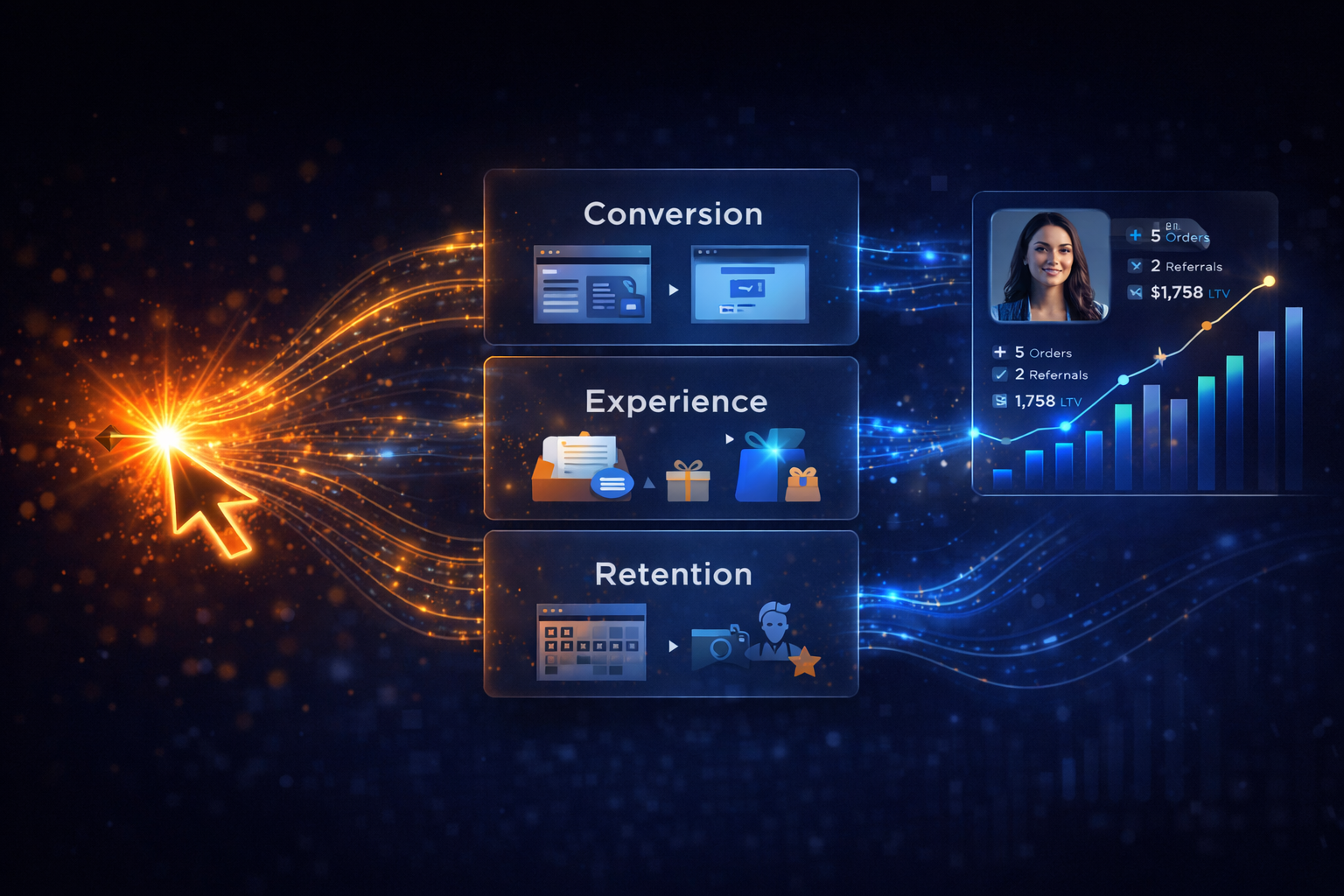
TL;DR: Getting someone to click is the cheapest part of e-commerce. Turning that click into a customer, and that customer into a repeat buyer, is where revenue is actually built or destroyed. This article breaks down the three-layer system that high-performing e-commerce brands use in 2026: a conversion layer that removes friction from the path to purchase, a post-click experience layer that turns transactions into relationships, and a retention and LTV layer that compounds the value of every customer acquired. Each layer is interconnected. Optimising one without the others is why most CRO programmes produce short-term lifts and long-term disappointment.
The Acquisition Trap
There is a pattern that repeats itself across e-commerce brands at almost every scale.
The marketing team runs well-targeted paid campaigns, traffic grows, and the business celebrates. Then cost-per-acquisition creeps upward, margins compress, and the brand runs promotions that train its customer base to wait for discounts. The ad budget increases to compensate. The cycle continues.
This is not a marketing problem. It is a structural one: the business has built its growth model on the most expensive and fragile part of the revenue equation, acquiring new customers, while underinvesting in everything that determines what happens after the click.
Harvard Business Review's research on customer retention puts the cost of this imbalance plainly: acquiring a new customer is five to 25 times more expensive than retaining an existing one. Bain & Company sharpens the financial implication: a 5% increase in customer retention produces more than a 25% increase in profit. These figures describe a specific, correctable misallocation of resources operating inside the majority of e-commerce businesses right now.
The brands structurally outperforming in 2026 are not necessarily spending more on acquisition. They are extracting more value from every customer they acquire, through what might be called a revenue optimization engine: a connected system of conversion mechanics, post-click experience design, and retention infrastructure that compounds the return on every euro or dollar spent bringing someone to the site.
What a Revenue Optimization Engine Actually Is
A revenue optimization engine is not a collection of CRO hacks or a loyalty programme bolted onto a standard checkout. It is a deliberate, integrated system built across three connected layers, each of which feeds the next.
The first layer is conversion, everything from landing page to completed purchase. Its job is to ensure that the traffic you have earned or paid for is not leaking through friction, confusion, or technical failure before it becomes revenue.
The second layer is the post-click experience, everything that happens between a completed purchase and the customer's next decision about your brand. This is the most chronically underinvested layer in e-commerce, and the one where retention actually begins, not in the retention team's email sequences, but in the quality of experience that immediately follows every transaction.
The third layer is retention and LTV mechanics, the system that determines how long customers stay, how much they spend, and whether they refer others. This is where the acquisition investment is ultimately paid back, or not.
Each layer depends on the others. High conversion rates mean nothing if the post-purchase experience produces one-time buyers. Strong retention programmes cannot compensate for a conversion funnel that fails to deliver customers in the first place.
Conversion: Removing Friction from the Path to Purchase
The Real Scale of the Abandonment Problem
Baymard Institute's research, built on over 200,000 hours of original UX testing across 327 major e-commerce sites, puts the average cart abandonment rate at 70.19%. On a site generating 100,000 sessions a month, that means more than 70,000 people who showed enough intent to add something to their cart are leaving without buying.
A portion of this is unavoidable. Baymard estimates that 58.6% of US online shoppers abandon because they were simply browsing and not ready to buy. But when those sessions are removed and only intent-based abandonment is examined, the picture changes.
Among shoppers who genuinely intended to purchase, 48% abandoned because of unexpected extra costs appearing at checkout, shipping fees, taxes, handling charges, and 18% left because the checkout process was too long or complicated. These are design problems, not demand problems. They are correctable.
The Checkout Is the Most Expensive UX Problem in E-commerce
Baymard's benchmark database reveals that the average US checkout contains 23.48 form elements by default. Their research shows an optimal checkout needs only 12:
- 7 form fields
- 2 checkboxes
- 2 drop-downs
- 1 radio button.
That gap between 23 and 12 is the largest single controllable source of conversion loss in most e-commerce operations.
The implication is substantial: Baymard's analysis of Fortune 500 e-commerce sites, Walmart, Amazon, Wayfair, ASOS, found that the average large site can achieve a 35.26% increase in conversion rate through better checkout design alone. Even at the top of the industry, the average site has 39 potential areas for checkout improvement.
Shopify's data reinforces the mobile dimension of this problem. As of Q3 2025, smartphones accounted for 78% of global retail site visits and generated around 70% of all online shopping orders, yet mobile carries the highest cart abandonment rate at 85.65%, compared to 73.76%.
Conversion Optimisation Priorities That Actually Move the Needle
The highest-return CRO activities in 2026 are those addressing the highest-volume friction points, not those producing the most interesting A/B test results. Baymard's research clusters these around five areas.
Price transparency
Early in the journey is the single most impactful change most e-commerce sites can make. Presenting shipping costs, taxes, and fees at the product page level eliminates the most common reason for abandonment.
Counterintuitively, showing a higher total price earlier reduces the trust erosion that comes from discovering additional costs at the payment step, which is far more damaging to conversion than the cost itself.
Checkout length reduction
Requires a structured audit of every field. The question for each is not "is this useful?" but "is this required at checkout, or can it be collected later?" Phone number fields are a consistent example: Baymard found that 14% of users abandon checkout when a phone number is required without explanation.
Guest checkout prominence
Matters more than most brands realise. Baymard found that 47% of sites fail to make guest checkout the most prominent option, forcing account creation before purchase is well-documented as a friction source, despite being entirely avoidable.
Mobile-specific optimisation
Deserves dedicated attention rather than being treated as a responsive design byproduct. Autofilling address fields, using input masks for card and phone numbers, and minimising typing requirements are all measurable conversion drivers on mobile.
Page speed remains foundational. Shopify's data shows a conversion drop of up to 20% for every one-second delay on mobile.
Personalisation as a Conversion Driver
McKinsey's research on the value of personalisation establishes a consistent 10 to 15% revenue lift from personalising the on-site experience, with company-specific lift reaching 5 to 25% depending on execution. Shopify's CRO data supports a related finding: personalising content for different demographics can increase conversions by upward of 30%.
The Post-Click Experience: Where Retention Actually Begins
The Most Underinvested Layer in E-commerce
The conventional view of e-commerce splits the customer journey into pre-purchase and post-purchase phases. This framing misses the most commercially important moment in the relationship, the experience immediately after a transaction. This is when customers form their lasting impression of a brand and make their first sub-conscious calculation about whether they will return.
Harvard Business Review's research on the post-purchase experience makes this case directly. McKinsey's "Next Best Experience" research, published in October 2025, quantifies what happens when this layer is designed rather than defaulted: companies deploying AI-powered post-purchase personalisation see customer satisfaction improve by 15 to 20%, revenue increase by 5 to 8%, and cost to serve decrease by 20 to 30%.
Designing the Post-Purchase Experience
The post-purchase experience has several distinct moments, each of which is either designed or defaulted. Most e-commerce brands default.
The order confirmation page is typically treated as a receipt and a dead end. It is, in practice, one of the highest-attention moments in the customer journey, the customer has just made a decision and is in a state of active engagement with the brand.
This is the right moment to reinforce that decision, introduce a loyalty mechanism, invite a referral, or surface a complementary product. None of these are aggressive upsells. They are extensions of an experience the customer is already invested in.
The post-purchase email sequence, the window between order confirmation and delivery, is where the brand either demonstrates that the customer relationship matters or confirms that the interaction was purely transactional.
The brands that perform best in this window communicate proactively, personalise based on what was purchased, and deliver value beyond tracking updates. A brand that sends a relevant how-to guide for the product ordered is doing something structurally different from one that sends only a shipping notification. Both are post-purchase communications. Only one builds a relationship.
McKinsey's personalisation research is precise on the stakes: 71% of consumers expect personalised interactions, and 76% get frustrated when they don't receive them. Companies that grow faster drive 40% more of their revenue from personalisation than slower-growing counterparts.
These figures apply as powerfully to the post-purchase window as to the pre-purchase one, arguably more so, because post-purchase is when customer attention and goodwill are highest.
The Role of AI in Post-Click Experience Design
McKinsey's January 2025 research on personalised marketing documents a shift from segment-based communication to AI-driven systems capable of generating bespoke content at the individual level, at scale.
The mechanism involves three model types working in concert: propensity models scoring how likely a specific customer is to churn or respond to a particular communication; channel models determining the most effective touchpoint for that customer at that moment; and value models calculating the LTV or near-term revenue opportunity. These outputs feed a decision orchestration layer that determines the actual experience delivered.
The practical implication:
The post-purchase experience is moving from designing one journey and personalising elements of it, to designing a system that generates the appropriate journey for each customer dynamically. The gap between brands deploying this and those relying on static sequences is widening.
Retention and LTV: Where the Acquisition Investment Is Paid Back
Why LTV Changes the Economics of Everything
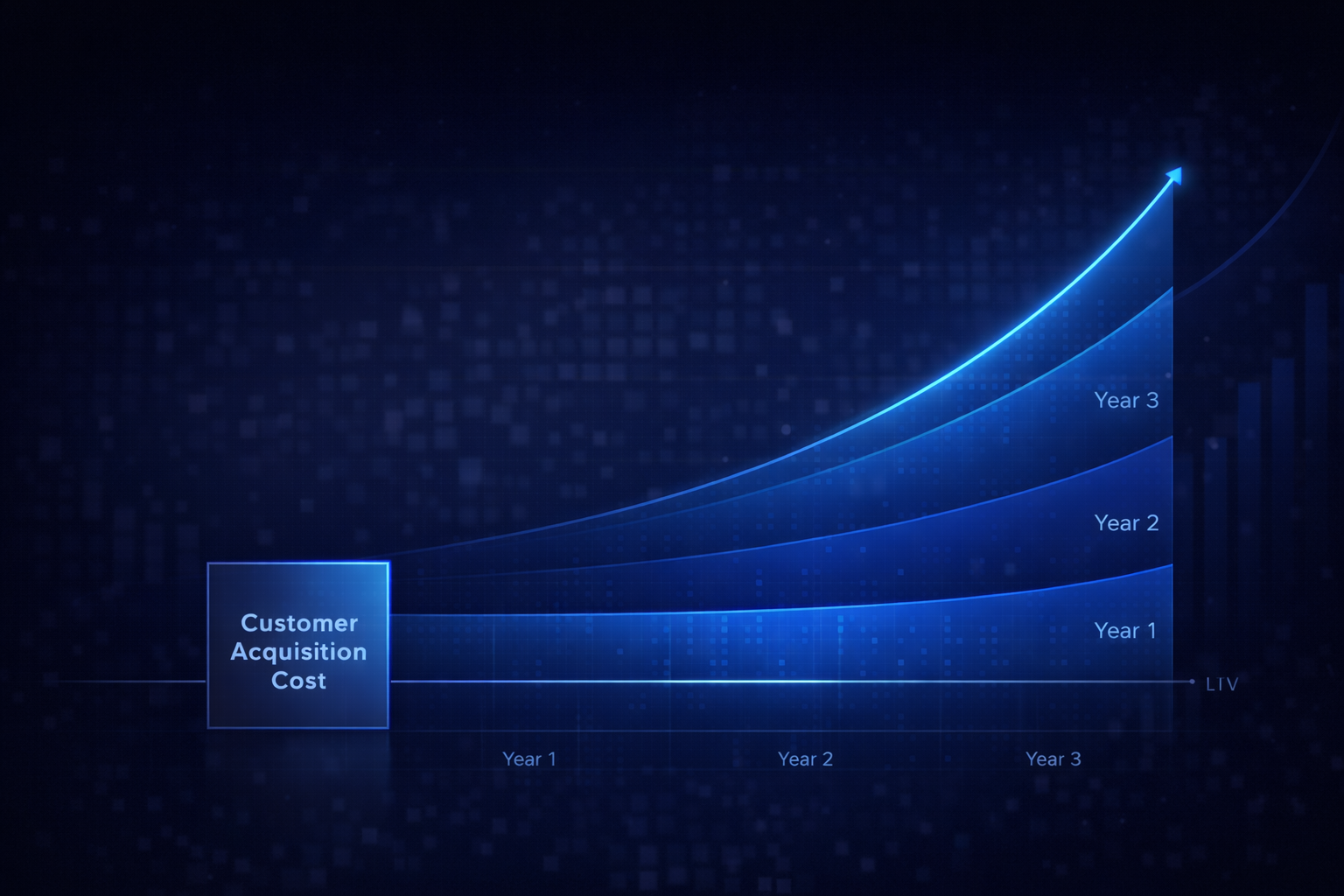
Bain & Company's online customer loyalty research established a foundational e-commerce truth: except for high-ticket items, in almost no instance can an online retailer break even on a one-time shopper. The cost of acquiring a customer exceeds the margin from a single purchase across most product categories. The business only becomes profitable on that customer when they return.
This is not an argument against acquisition. It is an argument for building the retention mechanics that make acquisition economically recoverable. Bain's research across a wide range of businesses found that customers generate increasing profits each year they stay with a company, because returning customers buy more, cost less to serve, and refer to others, none of which appears in a single-purchase margin calculation.
McKinsey frames the strategic implication clearly: leading companies treat CLV as a core steering metric rather than a reporting output, using cohort-based analytics to understand which customers are worth investing in retaining and which acquisition channels produce the highest-LTV cohorts.
Retention Mechanics That Compound
Retention is the output of every experience a customer has with a brand. But within that, specific mechanics consistently drive repeat purchase behaviour.
Cohort-based LTV analysis is the prerequisite for everything else. Without understanding which customers are worth investing in retaining, retention budgets are allocated by assumption. McKinsey's customer lifecycle management research is explicit: deep analytics providing a 360-degree customer view are the foundation of any effective retention system.
Propensity modelling identifies churn risk before it becomes churn. McKinsey's next best experience research describes the operational logic: a customer flagged as high-churn risk is automatically removed from promotional campaigns and moved into a retention journey involving loyalty offers or service improvements.
A customer with low-churn risk but high-upsell probability receives a proactive upgrade message. This requires integrated data infrastructure, connecting purchase history, engagement signals, and support interactions, but the brands building it now are creating a compounding structural advantage.
Subscription and replenishment mechanics, where appropriate, restructure the relationship between CAC and LTV fundamentally. A customer acquired into a subscription has a calculable LTV from day one rather than a probabilistic one, which changes how much the brand can rationally spend to acquire them.
Loyalty infrastructure built on designed experiences of recognition and value, rather than discount-driven points programmes, produces more durable retention.
Bain's research is direct:
Price-led retention fails when the service experience doesn't reflect the brand's stated value. The most durable retention is not bought with codes. It is built through the consistent experience of being treated as a customer the brand actually values.
Personalisation as the LTV Multiplier
McKinsey's Next in Personalization research identifies a compounding dynamic that has direct implications for LTV strategy: recurring customer interactions create more data, which enables more relevant experiences, which drives higher repeat engagement, which generates more data. This flywheel effect is the mechanism through which personalisation becomes a structural competitive advantage rather than a tactical one.
The scale of the opportunity McKinsey quantifies is significant: across US industries, shifting to top-quartile performance in personalisation would generate over $1 trillion in value. That figure is not primarily driven by converting more first-time visitors. It is driven by growing the LTV of customers who already exist.
Why Integration Is the Differentiator
Most CRO programmes, post-purchase redesigns, and loyalty initiatives underperform not because they are poorly executed within their own scope, but because they are executed in isolation.
A brand that reduces checkout friction and lifts conversion by 15% has made a genuine improvement, but if the post-purchase experience is generic and the retention infrastructure is underdeveloped, most of the new customers that improvement generates will buy once and leave. The conversion gain produces more customers. The absence of a retention system means it produces few loyal ones.
Equally, a sophisticated personalisation and retention system built on top of a leaking conversion funnel is spending to retain customers it is simultaneously failing to acquire efficiently.
The revenue optimization engine works because it treats these three layers as one system with one goal: the maximum return from every customer the brand touches, from first click to full expression of lifetime value. Conversion feeds retention with higher-quality first transactions. Post-click experience builds the relationship that makes retention possible. Retention validates the acquisition investment and funds the next growth cycle.
In 2026, with the average global e-commerce conversion rate at 1.58% and customer acquisition costs continuing to rise, the brands that win are not those with the largest media budgets. They are those with the most efficient engines, the ones that extract the most value from every click they have already paid for.
Resources
- Baymard Institute, "50 Cart Abandonment Rate Statistics 2026 — Cart & Checkout Research": baymard.com
- Baymard Institute, "E-Commerce Checkout Usability: An Original Research Study" (200,000+ hours of UX testing, 327 sites benchmarked): baymard.com
- Baymard Institute, "40+ UX Statistics from 200,000 Hours of UX Research": baymard.com
- Lars Fiedler & Nicolas Maechler (McKinsey), "Next Best Experience: How AI Can Power Every Customer Interaction", McKinsey, October 2025: mckinsey.com
- Eli Stein & Kelsey Robinson (McKinsey), "Unlocking the Next Frontier of Personalized Marketing", McKinsey, January 2025: mckinsey.com
- Nidhi Arora, Lars Fiedler et al. (McKinsey), "The Value of Getting Personalization Right — or Wrong — Is Multiplying", McKinsey Next in Personalization 2021 Report: mckinsey.com
- McKinsey & Company, "The Agentic Commerce Opportunity", October 2025: mckinsey.com
- McKinsey & Company, "Customer Lifetime Value: The Customer Compass": mckinsey.com
- Amy Gallo (Harvard Business Review), "The Value of Keeping the Right Customers", October 2014: hbr.org
- Harvard Business Review, "Online Retailers Should Care More About the Post-Purchase Experience", May 2016: hbr.org
- Harvard Business Review, "In a Downturn, Focus on Existing Customers — Not Potential Ones", December 2022: hbr.org
- Bain & Company, "Retaining Customers Is the Real Challenge": bain.com
- Bain & Company, "The Value of Online Customer Loyalty and How You Can Capture It": bain.com
- Bain & Company, "Prescription for Cutting Costs" (Fred Reichheld): bain.com
- Shopify, "Ecommerce Conversion Rate: How to Improve Yours (2026)": shopify.com
- Shopify, "CRO Statistics: 34 Vital Conversion Rate Optimization Stats (2025)": shopify.com
- Shopify, "What Is Global Ecommerce? Trends and How to Expand Your Operation (2026)": shopify.com