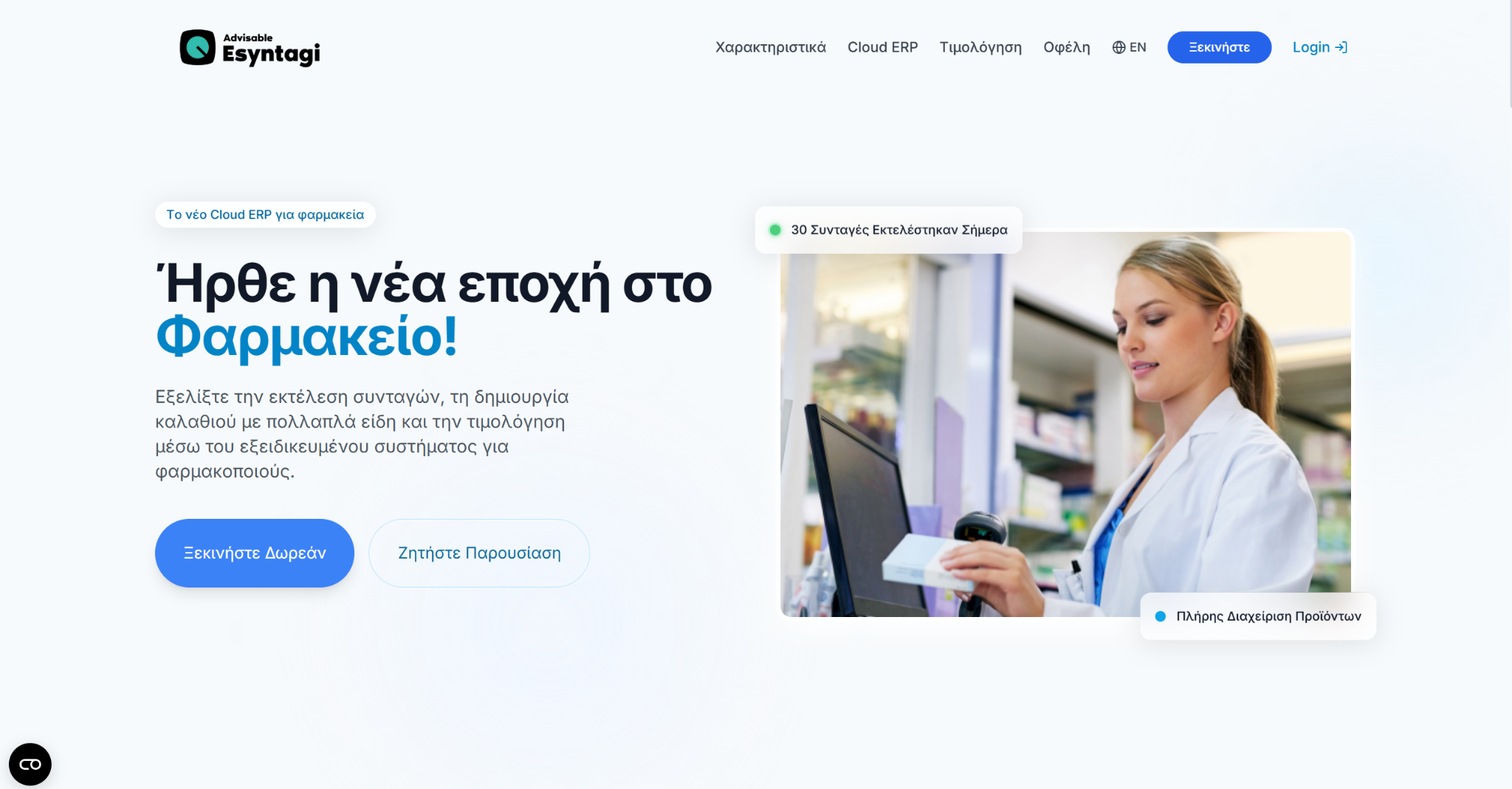
TLDR A routine pharmacy sale can touch the national e-prescription platform, the medicine verification system, the tax authority, the card terminal and the insurance funds. Each handover creates another opportunity for delay, duplication or error. eSyntagi brings those steps into one browser-based flow, so the pharmacist can concentrate on the patient while the platform handles the transaction around them. The five situations below follow a fictional pharmacist through a normal shift and show what that means in practice.
Tuesday, 7:40 pm. Dimitra is working in her neighbourhood pharmacy in Athens with one assistant, Aris. Mr Giorgos is at the counter with a prescription for three blood-pressure medicines. Four people are waiting behind him, one of them holding a box of cough syrup and another trying to find an AMKA number on a phone.
None of this is unusual. The difficulty begins when one ordinary customer journey has to be carried through several systems that do not behave like one. Dimitra must execute the prescription, verify every medicine box, issue the correct legal document, send it to myDATA, take payment and preserve a record that will survive the monthly claim to EOPYY.
One customer and five systems
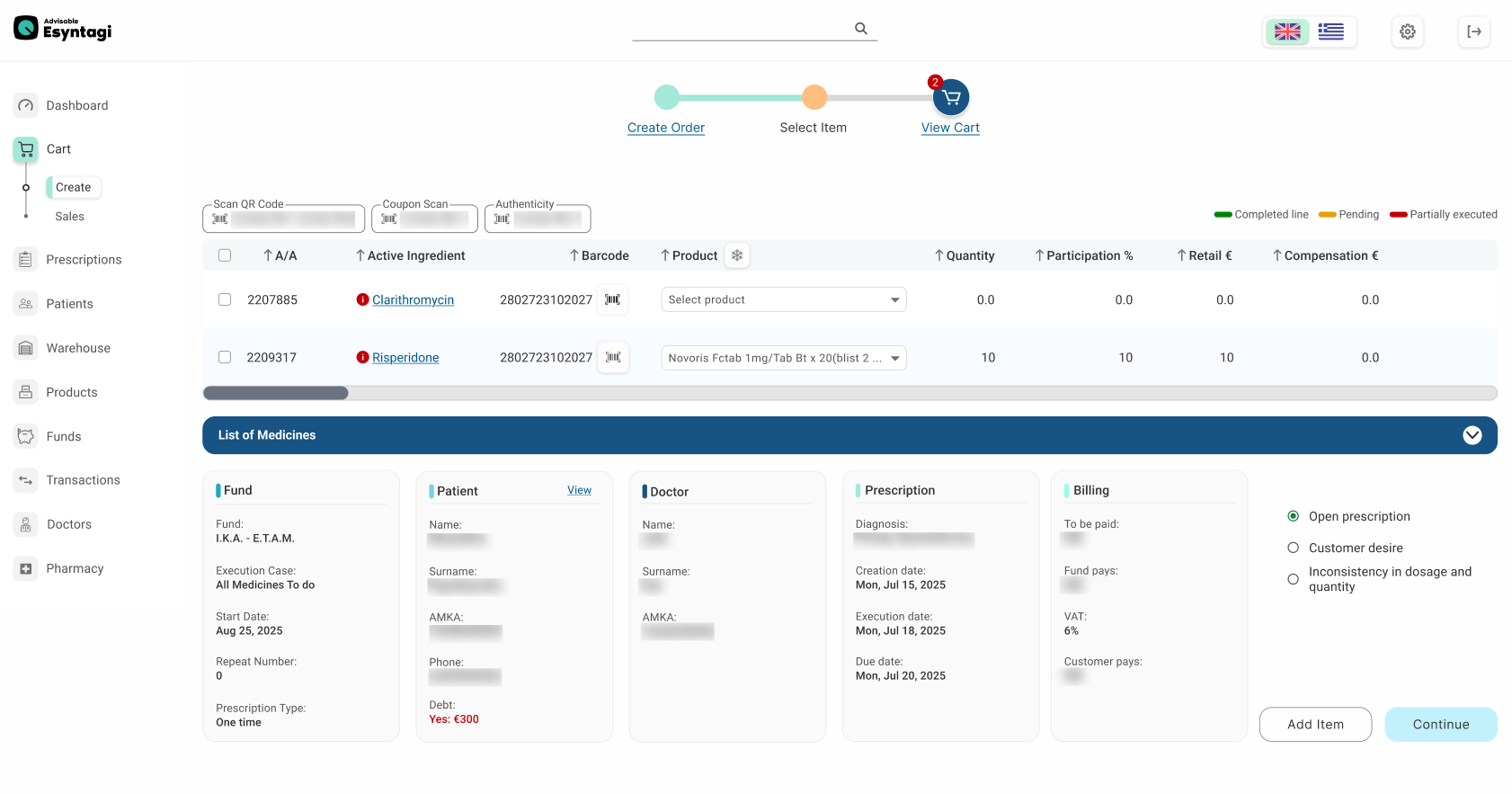
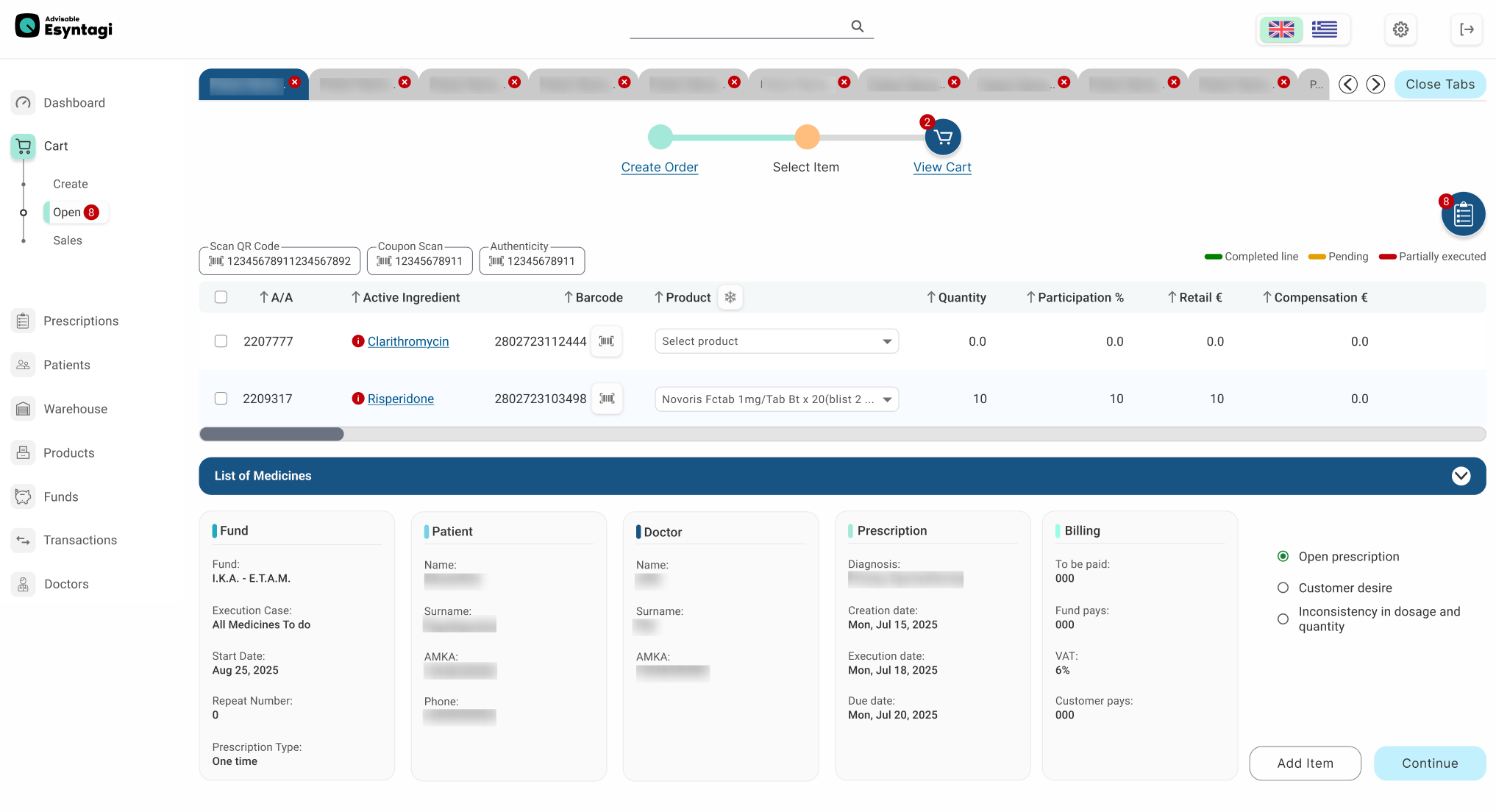
Mr Giorgos also wants a face cream. Dimitra scans the prescription and eSyntagi loads the patient, doctor and prescribed medicines. One product is out of stock. Instead of leaving the prescription to search elsewhere, she opens the equivalent-products view. The screen shows true equivalents with the same substance and strength, the stock in her pharmacy and her second branch, the patient contribution and the pharmacy margin.
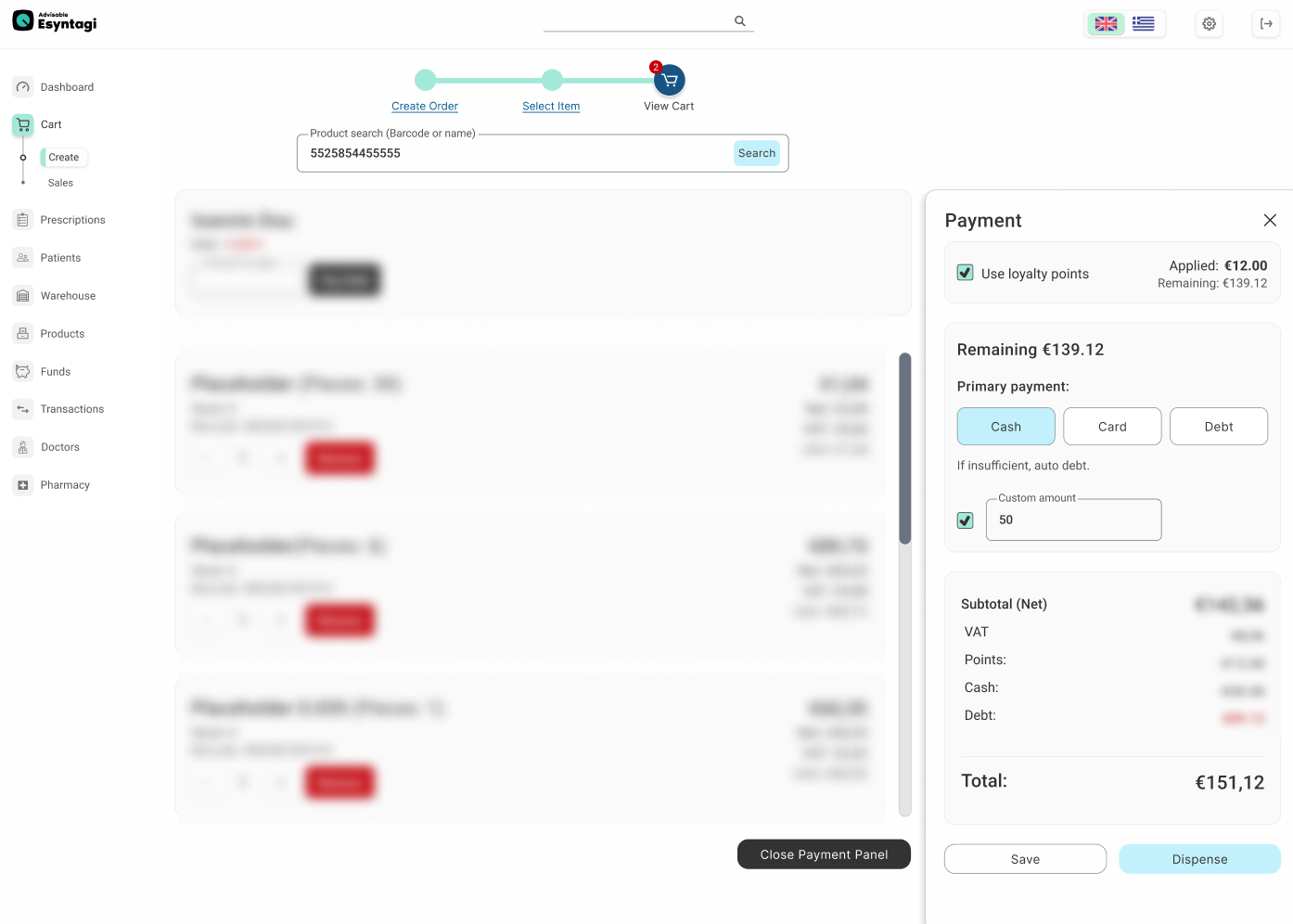
She selects an available equivalent, scans each medicine box and adds the cream to the same basket. The screen separates what Mr Giorgos pays from what the fund pays, including the prescription fee. His loyalty balance appears automatically.
Mr Giorgos chooses card. Dimitra taps Card once; the amount is sent directly to the active terminal and she confirms the sale with her personal PIN. That confirmation records the prescription with HDIKA, closes each box in the medicine verification system, issues the receipt through the certified provider to myDATA and deducts the loyalty points. The amount is not typed twice, and the prescription sale does not have to be reconstructed in a second application.
The same basket can contain retail products, several prescriptions, vaccinations and medicines handed over before a prescription arrives. For the person at the counter, it remains one purchase and one payment.
The box that was already dispensed
Since February 2025, the 2D code has replaced the EOF authenticity strip. The change connected dispensing more closely to medicine verification and introduced new failure points at the counter. Helpdesks have received cases involving boxes marked as already dispensed elsewhere, packs that cannot be reactivated after the permitted window and scanners that were not configured correctly.
During the same sale, Aris scans a second box delivered by the wholesaler that morning. eSyntagi rejects it before checkout and explains that its code has already been used. He sets it aside for investigation and takes another box from the shelf. The irregularity is visible while the pharmacist can still correct the transaction, rather than surfacing later among reimbursement or stock discrepancies.
The check runs for every prescribed pack. A wrong product, a duplicate scan or an already-used code cannot pass silently into the completed sale. A separate verification screen also lets authorised staff verify a pack, reactivate a returned pack or decommission one that was destroyed. Alerts from the national system are presented in plain language so the pharmacist can decide what to do next.
When a transaction stops halfway
On Saturday morning, Dimitra dispenses an antibiotic while the pharmacy is on duty. HDIKA accepts the prescription, but the e-invoicing provider does not respond. This is the dangerous kind of failure: part of the transaction has succeeded, part has not, and repeating everything could create a duplicate.
eSyntagi shows the state of each step. Dimitra can see that the prescription has been executed and the receipt remains pending. If the provider stays offline, the system issues a provisional receipt so the patient can leave with the medicine. When the service returns, eSyntagi sends the document automatically. Pending receipts remain visible in one list and are retried without a separate resend procedure.
The important difference is not that outside systems never fail. It is that staff can see what has already happened, recover from the interruption and avoid recording the same transaction twice.
The prescription that arrives in pieces
A regular customer, Mrs Maria, has run out of her blood-pressure medicine. Her doctor will issue the prescription later in the week. The medicine is handed over now, but without a reliable record it can be forgotten when the prescription arrives. A similar problem occurs when one prescribed product is unavailable, when a repeat prescription opens next month or when a patient wants to pay before collecting every item.
Dimitra records the medicine against Mrs Maria's patient history. When the prescription arrives on Thursday, eSyntagi matches it to what was already supplied. A second product is still unavailable, so Dimitra dispenses the first item and records why the rest remains open. Mrs Maria pays her full contribution now; when she returns, the remaining product appears as prepaid with nothing further to collect.
Repeat and future prescriptions remain in a calendar with statuses such as pending, reminded, ready, executed and overdue. Prescriptions approaching expiry are brought to the pharmacist's attention. Prepared orders move from waiting to ready for pickup and then collected, giving the team one shared record instead of relying on memory or notes beside the till.
While Mrs Maria looks for her AMKA, Aris parks her basket and serves the next person. eSyntagi can keep up to 20 customer baskets in progress, each separate and ready to reopen. His personal PIN identifies the eventual sale, while permissions set by Dimitra determine which counter, stockroom and financial screens he can access.
The money still outside the pharmacy
For the pharmacy, an executed prescription is also working capital already committed. The medicine has left the shelf and the staff time has been spent, but payment follows later: an advance first and the remaining balance after audit. In June 2026, the Ministry of Health told Parliament that the final 5 percent for February had not yet been cleared.
The pressure is not only the waiting. A formal error, an incorrect document type or a missed requirement can delay payment or reduce it. Thanos Koutsoukis, President of the Larissa Pharmacists' Association, expressed the wider frustration plainly:
“It is unfair for a pharmacist to lose money because they happened not to see a notification.”
The reimbursement timetable and the notifications issued by public platforms sit outside the individual pharmacy. What Dimitra can control is whether her own documents were prepared correctly, transmitted and accepted, and whether a rejection still needs action.
At the end of the month, eSyntagi prepares the claim to EOPYY, shows Dimitra a preview and sends it to KMES. The fund invoice is issued through the government's electronic-invoicing channel. Its status remains visible as accepted or rejected; a rejected invoice can be corrected and resubmitted from the same working environment.
The dashboard shows the amount currently being claimed from EOPYY. The prescription reports show what was claimed, what has been paid, what remains outstanding and how old that debt is. The delay may still exist, but the pharmacy no longer has to reconstruct its position from separate files and portals.
More time at the counter for the patient
Back at the counter, Mr Giorgos leaves with the correct medicines and one receipt for the complete purchase. Dimitra did not have to repeat the card amount, remember which verification step had completed or copy the sale into a second record. The exact time saved will vary from one pharmacy to another. What changes is where the repeated work disappears.
That is the purpose of eSyntagi: to connect prescription execution, medicine verification, checkout, invoicing, payment, stock and reimbursement tracking in one pharmacy platform. Clinical judgement remains with the pharmacist. The surrounding administration becomes easier to see and harder to lose between systems.
eSyntagi runs in an ordinary web browser, with nothing to install, in Greek and English. One login can cover several branches, while each employee sees only the sections needed for their role.
Want to see it at your own counter? Visit esyntagi.gr
Resources
Ministry of Health — Σημεία από την συνέντευξη τύπου για την έναρξη λειτουργίας του Ελληνικού Οργανισμού Επαλήθευσης Φαρμάκων (HMVO)
Europost — Φαρμακοποιοί σε… απόγνωση! Προβλήματα στην εφαρμογή του νέου συστήματος QR code για τα φάρμακα
Ελληνική Εταιρία Φαρμακευτικού Management — Tα 10 προβλήματα της σειριοποίησης των φαρμάκων
Πανελλήνιος Φαρμακευτικός Σύλλογος — Νομιμοποίηση της προχορήγησης φαρμάκων μέσω ΗΔΙΚΑ – Νέες Εφαρμογές στο Σύστημα της Ηλεκτρονικής Συνταγογράφησης
Hellenic Parliament — Απάντηση Υπουργείου Υγείας σε κοινοβουλευτικές ερωτήσεις (Αρ. Πρωτ. 16507, 16/06/2026)
Pharmacy Management — Φαρμακευτική αποζημίωση στο σύγχρονο φαρμακείο
Dailypharmanews — Θ. Κουτσούκης: «Είναι άδικο ένας φαρμακοποιός να χάνει χρήματα επειδή έτυχε να μη δει μία ειδοποίηση στην πλατφόρμα του ΕΟΠΥΥ»
iatronet — ΠΦΣ: Κίνδυνος να μείνουν απλήρωτοι οι φαρμακοποιοί από την 1η Ιουνίου - Εμπλοκή με τα ηλεκτρονικά τιμολόγια
Φαρμακευτικός Σύλλογος Ημαθίας — ΗΔΙΚΑ: Απορρίψεις παραστατικών MyData, σε παρόχους προγράμματος παχέος εντέρου
Pharmacy Management — Δυσκολίες και προκλήσεις στη λειτουργία του σημερινού φαρμακείου
Forin — ΕΟΠΥΥ: Ξεκινάει η διαδικασία δωρεάν διάθεσης Φαρμάκων Υψηλού Κόστους από τα φαρμακεία