
Before writing a single line of code, check these 7 market proof signals. A practical, research-backed guide for founders on the difference between evaluating and validating startup ideas, covering willingness to pay, competitor gap analysis, and AI-assisted customer discovery.
TL;DR: Most startups don't fail because they built badly, they fail because they built the wrong thing. The root cause, according to CB Insights' analysis of 100+ startup post-mortems, is moving into build mode before having real market proof. This article gives you 7 concrete signals to check first. Signals 1, 3, 5, and 6 are evaluation, they tell you whether a problem is real and worth exploring. Signals 2, 4, and 7 are behavioral validation, they tell you whether real people will commit money, time, or a signature to your solution. You need both, in that order, before you write a single line of code.
Why Most Founders Validate Too Late or Not at All
According to CB Insights' analysis of over 100 startup post-mortems, 42% of startups failed because they built something the market did not need. That makes "no market need" the single most common reason startups die, ahead of running out of cash (29%), having the wrong team (23%), or getting outcompeted (19%).
Read that again. Not bad execution. Not bad timing. Not bad luck. The leading cause of startup death is building the wrong thing entirely.
The uncomfortable truth is that this is also the most preventable failure mode, if only founders would know HCI, follow the Human Centered Design ISO used to build digital products and so perform upfront research before final commitment.
"The market pulls product out of the startup," Marc Andreessen wrote in his foundational 2007 essay on product-market fit. The operative word is pulls. If you are pushing your product into the market, explaining, convincing, persuading, you don't yet have proof. You have hope.
This checklist is designed to close that gap. It draws on frameworks from Y Combinator, Sean Ellis's benchmark research on product-market fit, Harvard Business Review, and the validated experience of venture-backed founders to give you seven concrete, honest signals, not opinions, not gut feelings, that tell you when an idea has earned the right to be built.
Evaluation, Validation, and Why the Difference Matters
Before getting into the signals, one distinction matters enormously, and the startup literature has made it worse, not better, by treating these terms as interchangeable.
Market Research
Market research maps the terrain. It tells you that a problem broadly exists, that a market is a certain size, and that a demographic shares a certain characteristic. It is useful as context, but it tells you nothing about whether real people will pay real money for your specific solution.
Evaluation
It reduces uncertainty. Interviews, surveys, competitor analysis, AI-assisted discovery, and review mining are all forms of evaluation. They help you determine whether a problem is real, how frequently it occurs, and how much friction it causes. They are essential, but they are not proof. People consistently say one thing and do another. Positive evaluation signals tell you an idea is worth exploring. They do not confirm that anyone will pay for it.
Validation
It confirms commitment through behavior. A pre-order, a signed letter of intent, a paid pilot, a design partnership, these require real action from real people and introduce real friction. Someone has to decide, internally justify, and commit to something they could have chosen not to do. That friction is precisely what makes it evidence rather than opinion.
The reason so many founders build products nobody adopts it's because they didn't do research, they were not trained for research or they actually completed their evaluation, ran the interviews, analyzed the competitors, mapped the market, and mistook that for validation. They had signals. They needed proof.
In this checklist, Signals 1, 3, 5, and 6 are evaluation signals. They reduce uncertainty and point toward an opportunity. Signals 2, 4, and 7 are behavioral validation signals. They confirm that the opportunity translates into a business. Both matter. But only one of them earns you the right to build.
The 7 Market Proof Signals
Signal 1: People are Already Solving this Problem but Badly
The most underrated evaluation signal isn't in a survey or a landing page. It's in the workarounds people have already built for themselves.
Spreadsheets duct-taped to email threads. Slack channels repurposed as makeshift project management tools. Manual processes that a ten-year-old piece of software should have automated a decade ago. When people are already investing time and energy into imperfect DIY solutions, you've confirmed two things at once: the problem is real, and the existing market has failed to solve it adequately.
Y Combinator's Michael Seibel frames this clearly in YC's foundational startup advice:
you need to find problems so urgent that users are "willing to try half-baked, v1, imperfect solutions."
If no one is even attempting to solve the problem themselves, with spreadsheets, with sticky notes, with manual effort, it may not be painful enough to build a business around. But when you find a pattern of workarounds across multiple unrelated people in different contexts, that is a strong evaluation signal that demand exists and that the market is underserved.
Where to look: job postings that hint at manual processes your product would automate; Reddit communities and niche forums where professionals share how they "manage X"; LinkedIn groups where people trade tips on solving the exact problem you've identified; and app store reviews for adjacent tools where users describe using the product in ways it was never designed for.
How to run this evaluation: Search relevant online communities for phrases like "how do you manage X," "anyone else using," or "I built a spreadsheet for this." Count the number of unique workarounds you find across unrelated users. If you identify five or more distinct, independent workarounds for the same underlying problem, you have a meaningful evaluation signal.
Signal 2: Strangers are Willing to Pay, they are not Just Interested
This is the most important signal on this list, and the one founders most consistently misread.
There is a dangerous gap between "this sounds great, keep me posted" and "here is my credit card." Enthusiasm is free. Money is evidence. As Shopify puts it in their research on product validation:
"Nothing confirms your product's value more clearly than customers willingly exchanging money for it. Until people pay you, your business is nothing more than a collection of assumptions."
The critical qualifier here is the word strangers. Friends, family, and professional contacts will tell you they'd pay for your idea. Most of them are being kind, not honest. Real behavioral validation requires people who have no social obligation to support you, people who hand over money purely because the value proposition compels them to.
Buffer's founder Joel Gascoigne validated the product before writing a single line of code by creating a two-page website. The first page explained the concept and had one call-to-action: "Plans and Pricing." Just clicking that button filtered casual interest from genuine intent.
The second page showed three pricing tiers. When visitors clicked a tier, they saw a message explaining the product wasn't quite ready, but Gascoigne could see exactly how many people had moved through the funnel, and which plan they'd selected. That behavioral data was his market proof.
For B2B founders, the equivalent is a letter of intent process or a paid pilot at a discounted rate. The price doesn't have to reflect your final pricing. What matters is that the person is committing something real, money, a signature, or significant time, in exchange for the promise of your solution.
To calibrate willingness to pay more precisely, consider using the Van Westendorp Price Sensitivity Meter, a four-question pricing survey that identifies the range of prices customers find acceptable, too cheap, or too expensive. It won't confirm whether people will buy, but it will tell you what a realistic price ceiling looks like before you lock in a pricing model.
How to check this signal: Offer a pre-order, a paid pilot at a meaningful discount, or a letter of intent process. If fewer than 5–10% of genuinely interested prospects are willing to make any financial commitment, treat that as a red flag, not a phase. One paying stranger is worth more than a hundred encouraging conversations.
Signal 3: Competitors Exist and Customers are Frustrated with Them
First-time founders often panic when they discover a competitor. They shouldn't. A market with no competition usually means there's no market at all. The existence of competing products is an evaluation signal, not a disqualifier, provided you can identify a specific, recurring gap in their offering. This is an evaluation exercise, not yet validation, it tells you whether the opportunity exists, not whether anyone will pay you to address it.
What you are looking for is the delta between what competitors promise and what customers actually experience. The richest source of competitor intelligence isn't their website or their pitch deck. It's their one-star reviews.
G2, Capterra, Trustpilot, the App Store, and Google Play reviews are essentially free, unfiltered customer research. When the same complaint appears repeatedly across multiple reviews from different users, that recurring pain point is your opportunity.
It represents a confirmed evaluation signal, a frustration that the incumbent is structurally unable or unwilling to address, often because fixing it would require them to rethink their core product, disrupt existing revenue streams, or serve a customer segment they've historically ignored.
Airbnb didn't invent short-term accommodation. They identified a specific recurring frustration with existing options, impersonal, expensive, and geographically limited, and addressed it directly.
Slack didn't invent team communication. It solved a specific and well-documented frustration with how email handled threaded, real-time collaboration. In both cases, the competitor's existence was evidence of a real market. The competitor's failure was the opportunity.
The key question after competitive analysis is not "can we beat them?" but rather: "Is there a specific, underserved segment whose problem our competitor is structurally unable or unwilling to solve, and is that segment large enough to build a business on?"
How to run this evaluation: Read 50–100 reviews of your top two or three competitors on G2, Capterra, or relevant app stores. Use a spreadsheet to tag recurring complaints by theme. Any theme appearing in more than 20% of negative reviews is a confirmed evaluation signal, a pain point the market has not solved, which is worth investigating further before moving to behavioral commitment testing.
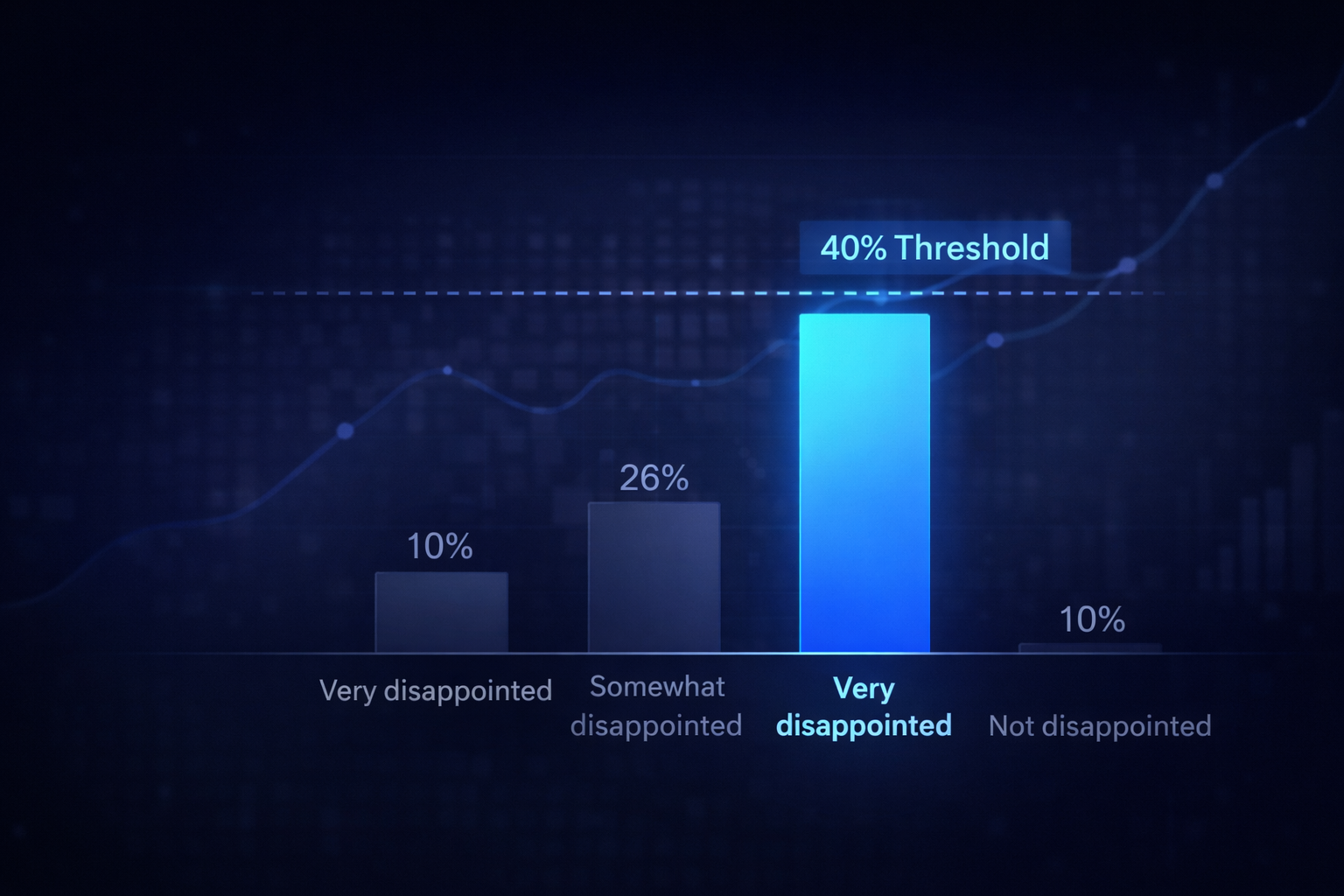
Signal 4: You can Cross the 40% Product-Market Fit Threshold
After working with early-stage growth at Dropbox, LogMeIn, and Eventbrite, entrepreneur Sean Ellis developed what has become the most widely used quantitative benchmark for product-market fit.
He asked users a single question: "How would you feel if you could no longer use this product?" Respondents chose from: Very disappointed, Somewhat disappointed, Not disappointed, or N/A.
After analyzing results across more than a hundred startups, Ellis found a consistent pattern: companies where at least 40% of users answered "very disappointed" almost always achieved sustainable growth. Companies below that threshold almost always struggled. The benchmark, now known as the Sean Ellis test or the 40% rule, has held up across hundreds of additional cases in the years since.
The Superhuman case study, documented in detail by First Round Capital, brought this framework into mainstream product thinking. Superhuman's founder Rahul Vohra used the 40% benchmark to build a structured engine for improving product-market fit, segmenting users by their answers, identifying what the most enthusiastic segment valued most, and systematically improving the experience for that segment before expanding. The result was a product that eventually achieved extraordinary word-of-mouth growth precisely because its core users found it genuinely indispensable.
In 2015, researcher Hiten Shah ran the Ellis survey with 731 Slack users when Slack had around 500,000 paying customers. Fifty-one percent said they'd be very disappointed without Slack. That single data point explained, more clearly than any growth chart, why the product had grown the way it did.
Importantly, you don't need thousands of users to run this test. Ellis himself recommended targeting users who have engaged with the core product at least twice in the past two weeks. You start getting directionally meaningful results around 40 respondents, far more accessible for early-stage founders than most assume.
How to check this signal: Run the Sean Ellis survey with your earliest users or beta participants. Limit the pool to people who have genuinely engaged with your product, not just signed up. If your score is below 40%, the qualitative responses explaining why people chose "somewhat" or "not disappointed" are your product roadmap. The gap between your current score and 40% tells you exactly what to fix.
Signal 5: Inbound Interest Arrives Without You Asking for It
Outbound evaluation, cold emails, LinkedIn outreach, asking contacts to spread the word, can generate responses, but it is contaminated by selection bias. You are chasing people. Inbound interest is the market reaching toward you, and that is a qualitatively different evaluation signal: it tells you the problem resonates, though it does not yet constitute behavioral validation.
Organic, unsolicited inbound means that something you've done or said about your product resonated enough that people sought you out independently. They didn't need to be asked. They found you, or they were referred to you by someone who also wasn't asked, which is the earliest form of word-of-mouth, and word-of-mouth is the earliest observable sign that a product-market fit hypothesis might be worth testing at the commitment level.
Inbound signals to watch for in the pre-launch phase include: organic sign-ups to a waitlist from people who discovered it through a third party; direct messages or emails from people who heard about your idea secondhand; journalists or analysts asking questions about your space; other founders asking how you think about the problem; and early waitlist members sharing your sign-up page without being incentivized to do so.
Even a small volume of these events, five to ten genuinely unprompted contacts, is a meaningful evaluation signal when you haven't invested in any formal marketing.
Dropbox's pre-launch approach captures this perfectly. Before building the product, founder Drew Houston posted a short demo video explaining the concept. Within 24 hours, 70,000 people had signed up for the waitlist, without a single dollar of paid marketing. That volume of unprompted response is rare, but even a fraction of it, proportional to your niche, is a strong evaluation signal.
Signal 6: AI-Assisted Discovery Reveals a Consistent, Unprompted Pain Pattern
This is the signal that has changed most significantly in 2025 and 2026. Customer discovery, the process of understanding whether a problem is real and widespread, used to require weeks of manual interviews, transcription, and thematic analysis.
AI tools have compressed that timeline substantially, but their most important contribution isn't speed. It's evaluation at scale, the ability to confirm whether pain language is consistent across unrelated people before you invest in behavioral commitment testing.
The most valuable thing AI-assisted discovery reveals is whether the pain language is consistent and unprompted across unrelated people. When different customers, in different contexts, with no knowledge of each other, describe the same frustration using remarkably similar words and emotional framing, that is an evaluation pattern worth building on. When their descriptions are vague, varied, or only emerge after you've led them toward the problem, that is a warning that the evaluation has not produced a meaningful signal.
Harvard Business Review's 2025 research on AI-assisted customer discovery found that when teams use AI to analyze conversations before engaging buyers, they begin interactions "from a stronger position that's more grounded in the customer's business challenges."
The same principle applies directly to pre-build evaluation. AI analysis of qualitative data, interview transcripts, competitor review forums, support ticket themes from adjacent tools, can surface pattern signals that individual human analysis would miss or misread due to confirmation bias.
In practice, this might involve using an AI tool to analyze 30–50 customer interview transcripts and identify recurring phrases, emotional triggers, and friction points. Or feeding a competitor's negative reviews into an AI for thematic clustering.
A16z-backed tools like Raspberry AI are going further still, allowing founders to generate synthetic customer personas and test value propositions against them before a single real interview has been conducted.
One essential caveat: AI-assisted discovery is an evaluation accelerator, not a substitute for real conversations, and it is categorically not behavioral validation. It helps you find the pattern faster and confirm its consistency at scale. But the original insight, the observation that something is wrong in a market, still begins with human attention, and the proof that someone will pay to fix it still requires behavioral commitment.
How to run this evaluation: Conduct 10–15 structured customer interviews using a consistent question script. Record and transcribe them. Run the transcripts through an AI tool and ask it to identify the three most recurring themes, the most emotionally charged language, and any phrases used independently by more than three different interviewees. If the same words and frustrations cluster across unrelated respondents, your evaluation signal is real and your messaging should mirror that language precisely.
Signal 7: Someone Has Committed With Money, Time, or a Signature
Every other signal on this list is evaluation, it reduces uncertainty and points toward an opportunity. Signal 7 is validation: it requires behavioral commitment, introduces real friction, and produces the kind of evidence that evaluation alone cannot generate.
A genuine commitment, a paid pilot, a pre-order, a letter of intent, or a design partnership agreement, transforms your idea from a hypothesis into a transaction, and transactions are the language the market speaks. This is the signal that separates a promising idea from a proven one.
In B2B contexts, a letter of intent is particularly powerful. Non-binding in legal terms, it nonetheless signals that a company is willing to put their name to their interest in your product before it exists.
That act, writing a name on a document, having it approved internally, sending it to an external party, involves real organizational friction. People only do it when the pain is real and the proposed solution is credible.
For early-stage B2B startups, a design partnership is often the most accessible and most valuable form of this commitment. A design partner is an organization that agrees to work closely with you during development, providing ongoing feedback, testing early versions, and in many cases paying a nominal fee in exchange for early access and influence over the product roadmap.
Securing two or three genuine design partnerships before building is among the strongest possible behavioral validation signals, because it demonstrates that organizations are willing to invest real resources in the problem being solved.
One pricing principle to internalize: never offer early access for free. Even a nominal payment, well below your intended price, demonstrates that the person values the solution enough to exchange something real for it.
Y Combinator's essential startup advice is direct on this point: free sign-ups are useful evaluation signals, but paying customers are a categorically different form of evidence. Free users validate curiosity. Paying users validate value.
How to check this signal: Before building, define what a commitment looks like in your specific context, a pre-order deposit, a signed LOI, a design partnership agreement, or payment for a manual concierge MVP. Set a specific target: three paid pilots, or ten pre-orders, or two design partnerships. Treat reaching that target as your green light to build. If you cannot reach it after genuine effort, the evaluation has produced insufficient grounds for commitment, and that is information you needed before spending your runway on development.
How Many Signals Do You Need?
There is no universal threshold, but a working rule used at venture studios and early-stage VC firms is this:
If you have Signal 2 and Signal 7, you have behavioral validation. If you have Signals 1, 3, 5, and 6 but neither Signal 2 nor Signal 7, you have completed a strong evaluation, which is valuable, but you have not yet validated. You have a hypothesis worth taking to commitment testing, not a green light to build.
Evaluation and behavioral validation are not competing activities. They are sequential ones. Evaluation tells you which direction to run. Behavioral validation tells you whether the ground is solid enough to build on. Skipping evaluation means you may commit resources to the wrong opportunity. Stopping at evaluation means you've done the research but avoided the risk, and avoiding the risk is precisely what prevents you from getting the proof.
A practical working rule: If you have five or more signals, with at least one being Signal 2 or Signal 7, you have earned the right to build an MVP. If you have fewer than five, or if all your signals are evaluative with no behavioral commitment attached, keep testing.
Conclusions
This is a checklist for a market-proven idea, one where real human beings, with real problems, have provided real behavioral evidence that they want what you're considering building. That is a higher bar. It is also the bar that separates the 10% of startups that survive from the 90% that don't.
The most important thing a venture studio does, the thing that separates the studio model from a solo founder working in isolation, is build the evaluation and validation infrastructure that makes rigorous proof possible before capital is committed. Market proof is not a bureaucratic checkpoint. It is the single most valuable thing you can produce before your first line of code.
Evaluate first. Validate second. Build third. In that order, every time.
Resources
- CB Insights, "The Top 12 Reasons Startups Fail", CB Insights Research Report: cbinsights.com
- CB Insights, "483 Startup Failure Post-Mortems", CB Insights Research: cbinsights.com
- Michael Seibel (Y Combinator), "The Real Product Market Fit", Y Combinator Blog: blog.ycombinator.com
- Y Combinator, "YC's Essential Startup Advice", Y Combinator Blog: ycombinator.com
- Marc Andreessen, "The Only Thing That Matters" (Guide to Startups, Part 4), pmarchive.com, 2007: pmarchive.com
- Rahul Vohra, "How Superhuman Built an Engine to Find Product-Market Fit", First Round Capital Review: review.firstround.com
- Ian Gross, "How Sales Teams Can Use Gen AI to Discover What Clients Need", Harvard Business Review, February 2025: hbr.org
- Shopify, "Product Validation: 9 Proven Strategies for 2025": shopify.com
- Justine Moore & Olivia Moore, "State of Consumer AI 2025: Product Hits, Misses, and What's Next", Andreessen Horowitz, December 2025: a16z.com
- Wikipedia, "Product-Market Fit" (cites Marc Andreessen, Sean Ellis, Andy Rachleff, Benchmark Capital): wikipedia.org