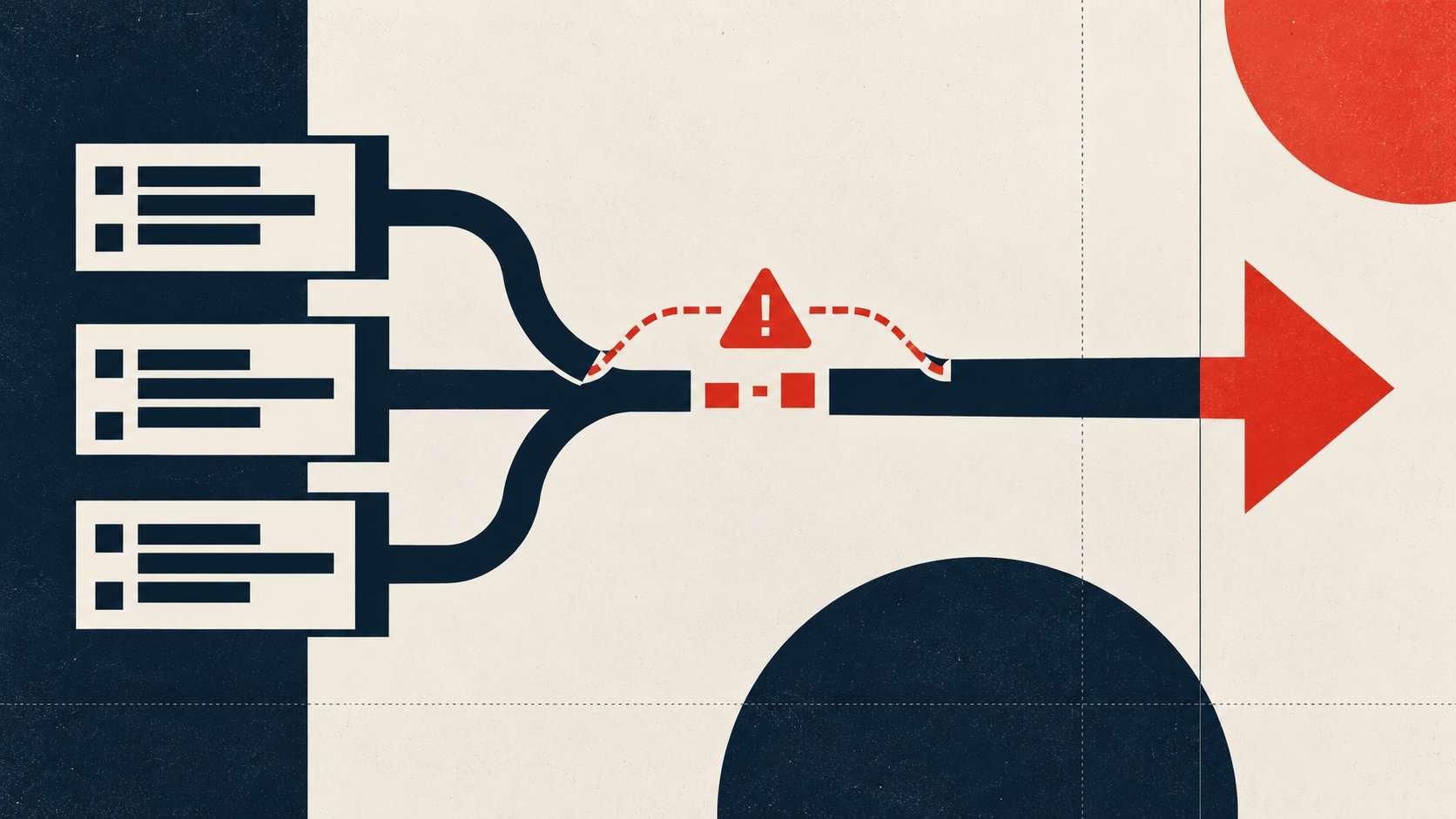

TL;DR: The threat to small SaaS products in 2026 is real, but it is more specific than most headlines suggest. AI giants are not killing micro-SaaS. They are killing shallow micro-SaaS, and the distinction between shallow and deep runs through everything.
Not all small software products face the same future: some are already dead, some are fragile but survivable, some are genuinely defensible, and a small group are stronger than they have ever been. Most founders have not yet worked out which of those four categories their product belongs to. This article is a framework for doing that honestly.
The Threat Is Real. So Is the Misdiagnosis.
In February 2026, a single week of news wiped roughly $2 trillion in market value from SaaS stocks. The catalyst was the simultaneous launch of OpenAI's Frontier enterprise agent platform and Anthropic's Claude Cowork agentic plugins, moves that sent investors into what Fortune's AI editor Jeremy Kahn described as the "paranoid-schizoid position," swinging between "all good" and "all bad" on software company valuations within days.
That market panic was driven by a genuine structural fear:
If AI agents can navigate Salesforce, run Workday workflows, and execute customer service without a human touching a keyboard, what happens to the per-seat licensing model that built the SaaS economy? And if that question applies to Salesforce, doesn't it apply even harder to the solo-founder product charging $29 a month to do one thing Salesforce doesn't do particularly well?
The answer is yes; and also no, depending entirely on what that product is.
The investors were asking the right question and getting the wrong answer. The threat is not uniform. It runs along a spectrum, and where your product sits on that spectrum determines almost everything about its near-term future.
Dead
AI wrappers and single-feature generic utilities, tools that were technology arbitrage plays rather than domain products. A standalone AI email writer, a basic social media scheduler with no proprietary data, a single-function dashboard that replicates what ChatGPT now does in a prompt. These were never real businesses. They were a window that opened in 2023 and closed by 2025.
Fragile
Horizontal SaaS with a UX or convenience advantage but no deep data, no proprietary workflow logic, and no distribution that a platform cannot replicate. These products still have customers and revenue today. The UX is genuinely better than what the big platforms ship. But the moat is thin enough that one good product cycle at Microsoft or Salesforce closes the gap, and those product cycles are happening faster now.
Defensible
Vertical SaaS with meaningful workflow integration, accumulating domain-specific data, and distribution through industry channels that generic platforms cannot reach economically. The dermatology clinic tool. The charter party tracking software. The compliance product for a specific regulatory regime. These are not going away, and the forces killing the categories above are actively reducing the competition these products face.
Powerful
Vertical SaaS that adds data network effects on top of the above, products where more users make the product smarter for every user, where the accumulated data becomes a training asset or a benchmarking resource, and where distribution is through professional communities with high trust and low switching appetite. This category is not just surviving. It is becoming more valuable as the horizontal market consolidates and serious buyers look for depth.
Before reading further, apply this test to your product:
If ChatGPT added your core feature tomorrow as a native capability, would your customers leave?
If the honest answer is yes, or probably yes, your product is in the first or second category. If your customers would not switch because the value they get from your product cannot be replicated by a generic AI feature, you are in the third or fourth.
Most founders know the answer before they finish reading the question.
What the Analysts Are Actually Saying
The smartest analysis of this moment does not come from the startup-advice ecosystem. It comes from Bain & Company's Technology Report 2025, which examined the agentic AI disruption of SaaS from a structural angle rather than a headlines angle.
Bain's framing is blunt: agentic AI is rebundling. SaaS spent two decades unbundling enterprise software into specialised point solutions. AI is now rebundling control on a three-layer stack, systems of record at the base, agent operating systems in the middle, and outcome interfaces at the top.
In this architecture, the question is not whether point solutions survive. It is which layer they sit in, and whether that layer has defensible value.
Bain's conclusion for most SaaS companies is similarly direct:
Pick a lane. Either become the neutral agent platform, or supply the unique data that powers it.
Very few companies, Salesforce is one Bain names specifically, can realistically do both. For the vast majority of software products, the viable path is being indispensable in the data layer for a specific domain, not competing to be the orchestration layer that everyone uses.
This maps cleanly onto the micro-SaaS question. A micro-SaaS product that owns proprietary workflow data for a specific industry, usage patterns, client histories, regulatory templates, pricing records, has exactly what Bain describes as defensible. A micro-SaaS product that is essentially a thin wrapper around a generic task has the opposite of that.
Foundation Capital's Ashu Garg, writing in December 2025, made a related observation from the investment side.
The "services as software" thesis, AI that delivers outcomes rather than selling seats, has become the default frame for B2B investing. What this means in practice:
Investors are no longer interested in products that automate a generic task more conveniently.
They are interested in products that deliver a specific outcome in a domain where generic automation cannot reach. That is the same distinction as above, framed from a funding rather than a product angle.
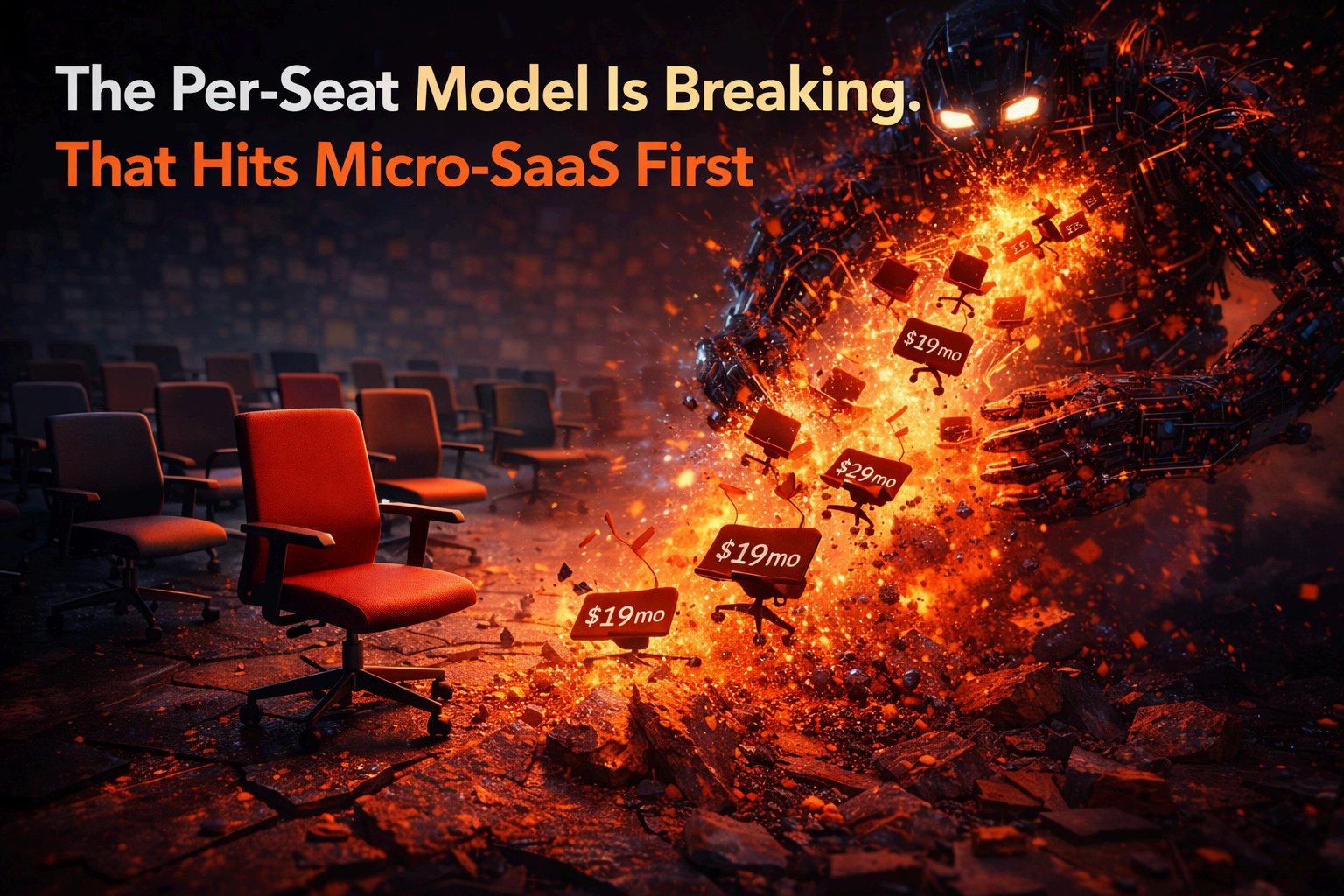
The Per-Seat Model Is Breaking. That Hits Micro-SaaS First.
One structural change that affects every SaaS product, but hits smaller products hardest, is the collapse of the per-seat pricing logic.
Fortune's reporting on the enterprise pivot captures the dynamic at scale:
- Salesforce is moving to an "Agentic Enterprise License Agreement" that offers flat-rate access to its agent platform rather than per-user pricing.
- ServiceNow is shifting to consumption-based models.
- Microsoft has introduced consumption pricing alongside its per-user Copilot Studio model.
The logic is simple:
If one AI agent can do the work previously requiring ten human seats, charging per seat is charging for something the customer no longer needs.
For enterprise SaaS, this is a margin pressure problem and a growth story disruption. For micro-SaaS, it is more existential. A small product charging $19 or $29 per month per user built its entire unit economics on a growing seat count. If the users of that product are being replaced, or their workload is being absorbed by a broader AI platform that handles the same task as one of twenty capabilities, the seat count does not grow. It shrinks or disappears.
This is particularly acute for the category sometimes called "AI wrappers", products built primarily as interfaces around an underlying LLM, without proprietary data, deep integrations, or vertical-specific logic.
These products had a window of viability in 2023 and 2024, when accessing and packaging AI capability was itself a competitive advantage. That window has mostly closed. The underlying models are now accessible to anyone, the interfaces have been commoditised, and the large platforms have absorbed most of the generic use cases as native features.
Where Micro-SaaS Still Has a Structural Advantage
The threat above is real. So is the counter-argument, and it deserves equal weight.
Large AI platforms are optimised for breadth. Their economics require large addressable markets, high usage volume, and generic applicability. The deeper a platform goes into a specific niche, the harder it is to justify the engineering investment against the customer base that would use it.
This is not a new observation, it is the original argument for micro-SaaS, but it becomes more rather than less true as the platforms get bigger. The larger Microsoft 365 Copilot becomes, the less interest Microsoft has in building workflows for independent veterinary practices in rural Portugal or for the specific compliance requirements of Greek shipping brokers. That gap grows as the platform grows.
There is a related point about trust and distribution. The users of deep-vertical software products are not shopping on Product Hunt. They are not switching tools because something cheaper appeared on an AppSumo deal. They found the tool through an industry contact, or a conference, or a professional association. They trained their team on it. Their data lives in it. The switching cost is not low, and the trigger for switching is not "a bigger company now does something similar." It is "this product stopped working for us specifically."
However, two caveats matter here and should not be glossed over.
The first is aggregation risk. Large platforms do not need to build your vertical product. They need to connect to it. An enterprise AI agent that can plug into your product via API or MCP, pull your data, and surface it in a conversation has effectively made your product a backend rather than a destination.
Your users still need what you store, but they may increasingly access it through a layer you do not control. This is a different kind of threat than being replaced: it is being disintermediated. The defense against it is owning the experience and the relationship, not just the data.
The second caveat is speed. AI has collapsed the time it takes to build a credible copy of almost anything. A vertical SaaS product that would have taken a well-funded competitor 18 months to replicate two years ago can now be rebuilt in weeks by a small team with access to modern AI development tools.
Being a niche is no longer sufficient protection on its own. The real moat is the combination of data, distribution, brand trust, and integration depth, the things that take time to accumulate even when the code can be written quickly.
A product with deep integrations into a vertical's existing toolstack, an established reputation in the professional community, and two years of workflow data is genuinely difficult to replicate even in an era of fast builds. A product that just operates in a niche but has none of those properties is more vulnerable than it looks.
This is why the survival question for micro-SaaS in 2026 is ultimately not about AI. It is about what you have actually built beneath the surface. The products that are losing are the ones that were never deep enough to generate real switching costs in the first place. The AI bundling threat exposed that weakness, it did not create it.
The AI Wrapper Extinction and What It Actually Means
The collapse of the AI wrapper category deserves honest examination, because it is often cited as evidence that micro-SaaS broadly is dying when the story is more specific.
An AI wrapper, a product that takes an LLM API, puts a UI around a particular use case, and charges for access, was a rational play in 2023 when GPT-4 was new and the difference between having access to it and not was itself valuable. By 2025, that advantage had evaporated.
The underlying models improved and proliferated, cost per token dropped dramatically, and every major platform integrated LLM capabilities natively. A standalone "AI email writer" or "AI social post generator" could not survive against the same functionality appearing as a native feature in Gmail, LinkedIn, or any enterprise suite.
What this extinction event proves is not that focused software products are dead. It is that the product needs to be focused on a problem domain, not on a technology layer. The products that are dying were never really micro-SaaS in the original sense, they were technology arbitrage plays dressed as products. The technology they were arbitraging, LLM access, became commodity faster than any of them anticipated.
Genuine micro-SaaS, the kind that has existed profitably since the WordPress plugin era, does not look like this. It looks like a tool that solves a recurring problem for a specific type of person, with enough depth that the solution feels like it was built for them. That category is not at risk of being eaten by AI feature bloat. In some cases, AI is making it cheaper and faster to build, which expands rather than contracts the opportunity.
The Pricing and Distribution Rethink
For founders currently running micro-SaaS products or considering building one, the strategic implications are practical.
Per-user pricing on shallow functionality should be treated as a warning sign, not a business model. If the value proposition is "do this one thing more conveniently," and the "one thing" is easily replicable by a platform feature, the pricing model will eventually break along with the product's reason to exist.
The direction of the market is toward outcome-based pricing, charging for a result delivered, not a seat filled, and micro-SaaS products that can frame their value in outcome terms are better positioned than those selling access.
Distribution into the niche matters more than ever. The broad channels that worked in the early SaaS era, Product Hunt launches, general SEO, AppSumo deals, are noisier and less effective as the volume of AI-generated products has increased exponentially.
A micro-SaaS product that distributes through the professional communities its users belong to, industry newsletters, vertical-specific Slack groups, professional associations, conference sponsorships, builds a customer base that is inherently stickier and harder for a generic platform to reach. This is not a new principle, but the pressure to execute on it well is higher now.
Proprietary data is the moat that matters. A product that captures workflow data, user preferences, historical records, or domain-specific context over time is building something that cannot be replicated by switching to a platform alternative.
The switching cost is the data. The product that is losing is the one that stores nothing, that processes a task and returns a result without building any persistent context. Those products are interchangeable with a single ChatGPT prompt.
The Honest Answer to the Headline Question
Micro-SaaS is not dying. Mediocre SaaS is.
The category being eaten alive is not defined by size or by the number of people who built it. It is defined by what it is made of. Generic functionality, no proprietary data, distribution that any platform can replicate, pricing built on seats that AI is replacing, that combination was always fragile. AI bundling exposed it faster than most founders expected.
The surviving category is harder to build than it looks. Deep vertical products with real data accumulation, distribution through professional communities that trust takes time to earn, and integrations that create genuine switching costs, these are not easy to produce, even with AI lowering the cost of code. They are survivable and in some cases thriving. But "survivable" is not the same as safe. Even defensible products will face pricing pressure, faster competition, and the aggregation risk of being turned into a backend by a platform agent. The ceiling is lower and the floor is higher than the optimists and pessimists respectively claim.
The founders who will do well in this environment are not the ones who picked the right niche. They are the ones who went deep enough inside it to be genuinely irreplaceable, and who are honest enough with themselves to know the difference between depth that is real and depth that just looks that way because nobody has bothered to compete yet.
Resources
- Bain & Company, "Will Agentic AI Disrupt SaaS?", Technology Report 2025: bain.com
- Fortune / Jeremy Kahn, "AI Agents from Anthropic and OpenAI Aren't Killing SaaS — But Incumbent Software Players Can't Sleep Easy", February 2026: fortune.com
- Fortune, "OpenAI Launches Frontier, an AI Agent Platform That Could Reshape Enterprise Software", February 2026: fortune.com
- Foundation Capital / Ashu Garg, "Where AI Is Headed in 2026", December 2025: foundationcapital.com
- BetterCloud, "AI and the SaaS Industry in 2026" (cites Mary Meeker's Bond Capital Report and Gartner data): bettercloud.com