
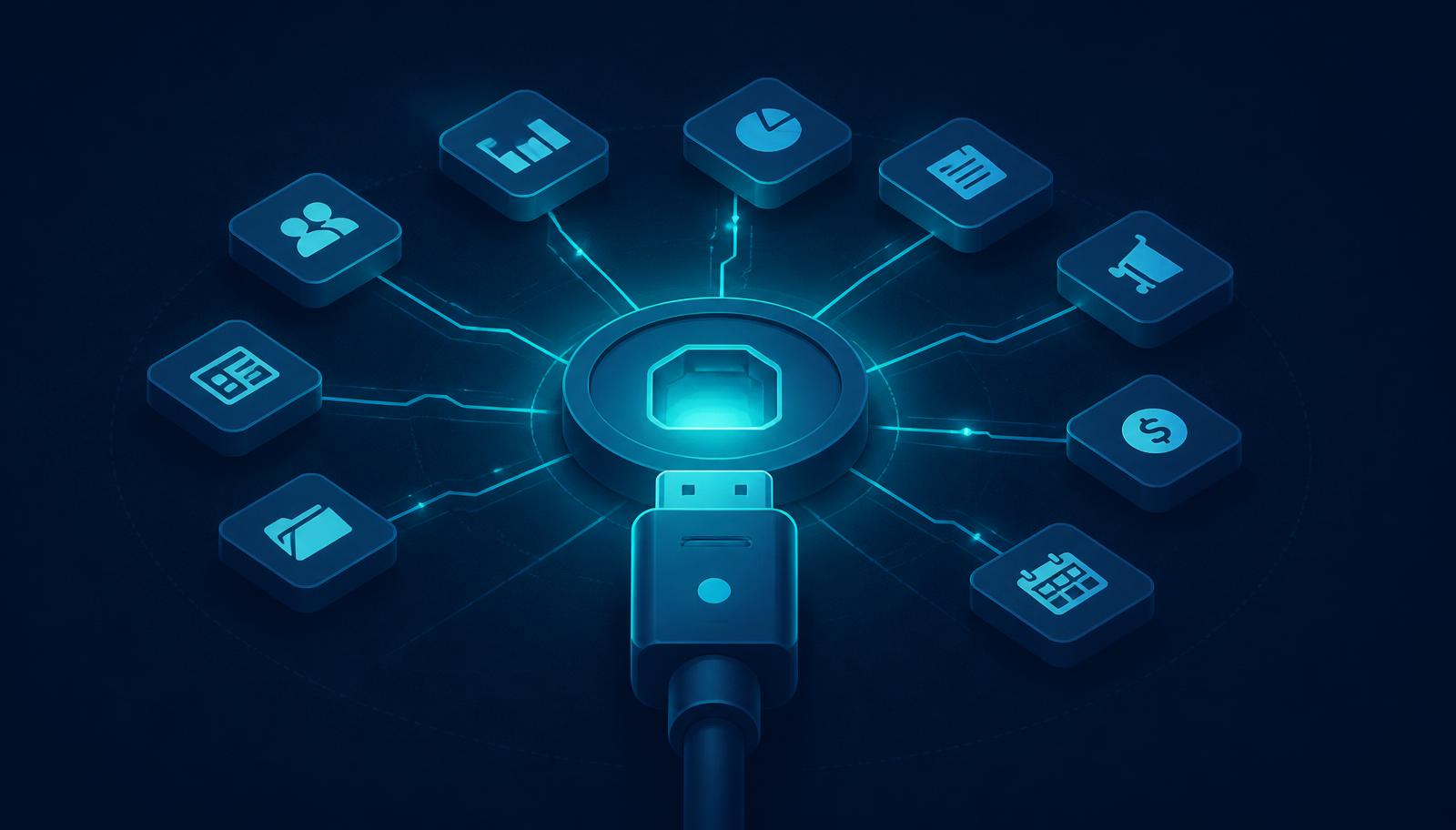
TL;DR: MCP (Model Context Protocol) is an open standard, originally released by Anthropic in late 2024, that lets AI models connect directly to business tools, data and APIs without a custom integration for every pairing. In 2026 it crossed from developer experiment to default enterprise integration layer, with major vendors standardizing around it and analysts projecting it will sit inside a large share of enterprise applications by year end. For businesses drowning in repetitive, cross-system manual work, it's the piece of infrastructure that finally makes AI automation reliable rather than a fragile demo.
The problem MCP was built to solve
Ask any operations, revenue or support leader what actually slows their team down and the answer is rarely "we don't have enough AI tools." It's this: the CRM, the ERP, the helpdesk and the data warehouse don't talk to each other, so someone spends their week copying data between systems, re-typing the same fields, and manually triaging tickets that a system should be able to route on its own. We hear this from clients constantly in our own AI automation and integration engagements: tools that don't interconnect and repetitive manual work eating the team's best hours.
Historically, fixing this meant building a custom integration for every tool-to-tool pairing, an N×M problem that multiplies every time you add a new system or a new AI application. Model Context Protocol exists specifically to collapse that complexity. Anthropic has described it as something like a USB-C port for AI applications: one standard connector that lets any AI model plug into any properly configured data source or tool, instead of a bespoke integration for every combination.
From experiment to default standard, in 18 months
MCP shipped as an open-source protocol in November 2024. What's notable is how quickly the rest of the industry lined up behind it rather than building a competing standard. Through 2025, OpenAI, Google DeepMind, Microsoft and Hugging Face all added native MCP support, and by late 2025 Anthropic donated the protocol itself to a vendor-neutral foundation under the Linux Foundation, co-founded with Block and OpenAI, putting governance in the hands of a community process rather than a single company's roadmap.
The adoption numbers back up the shift from curiosity to infrastructure. By mid-2026, the MCP ecosystem was reporting roughly 97 million monthly SDK downloads and more than 9,400 public MCP servers available for AI applications to connect to. Analysts have followed with concrete forecasts: Gartner projects that 40% of enterprise applications will include task-specific AI agents by the end of 2026, up from under 5% a year earlier, and Forrester expects roughly 30% of enterprise application vendors to ship their own MCP servers as a direct consequence.
CIO Magazine's coverage of the trend makes the underlying point plainly: the biggest barrier to enterprise AI has rarely been model quality, it has been integration complexity, and MCP is the first standard to meaningfully attack that barrier at the protocol level rather than the individual-project level.
What this looks like in practice
In concrete terms, an MCP connector lets an AI agent do things like:
- Pull live data on request from a CRM, ERP or data warehouse instead of working from a stale export someone emailed around
- Trigger actions inside existing tools, updating a ticket, enriching a lead record, drafting a reply, with human approval gates where the action warrants one
- Reuse the same connection across multiple AI applications, so a connector built once for your support system works whether the agent sits inside a chat interface, an internal copilot, or an automated workflow
- Standardize authentication and permissions, since the current MCP specification builds on OAuth 2.1 and defines how servers advertise what they can and can't do, rather than every integration inventing its own access model
Early enterprise deployments give a sense of the scale of the gains available. Block, the payments company, has reported reducing token usage across its internal AI agent platform by roughly 98.7% after adopting MCP as its integration layer, largely by eliminating redundant context-passing between tools. Coverage of enterprise rollouts also points to regulated industries, banking and financial services among them, using MCP-integrated AI for tasks like risk assessment and fraud checks that previously required manual cross-referencing between systems.
The part most write-ups skip: governance
MCP solves integration complexity, but it doesn't automatically solve security or oversight, and treating it as a plug-and-play shortcut is where early deployments run into trouble. The protocol's own 2026 roadmap has prioritized exactly this: standardizing OAuth-based authorization, requiring servers to advertise their capabilities and access scope up front, and building toward the kind of observability that lets a security team see what an agent actually did, not just what it was asked to do.
Practically, that means a sound MCP rollout treats access the same way you'd treat any system integration with write permissions: start with read-only connections for reporting and knowledge lookup, add write actions deliberately, and keep a human approval step on anything that touches customer-facing systems, financial data or CRM records at scale. This is standard practice in the AI Agents Engineering and System & API Integration work we run for clients, tool-use and permissioning are designed in from the first architecture conversation, not retrofitted after a proof of concept works.
Why this matters more than the acronym suggests
The reason MCP is worth understanding now, rather than filing under "developer infrastructure," is that it changes what's realistically automatable. Workflows that used to require a bespoke integration project, and therefore never made it past the "someday" backlog, become reachable once the connector already exists in a public registry or can be stood up once and reused everywhere. Sales ops enrichment, support ticket triage, invoice reconciliation, internal knowledge search across your wiki and contracts, these are exactly the categories where MCP-based agents are showing up first, because they're high-volume, rules-can-be-defined, and previously too fragmented across tools to automate cleanly.
It's also worth pairing this with a point we make in our companion piece on AI training: standing up MCP connectors is an engineering and governance decision, but getting value out of the agents that use them still depends on teams that understand what the agent is doing and when to intervene. The businesses getting ahead here aren't just wiring up connectors, they're training the people who'll supervise and refine what those agents do.
Where to start
You don't need to connect everything at once, and you shouldn't. The pattern that works is the same discovery-first approach behind any of our custom AI solutions for enterprises: map which repetitive, cross-system tasks are eating the most hours, prioritize by ROI and risk, and connect the highest-value systems first with the right permission boundaries from day one.
Curious what an MCP-based integration could take off your team's plate? Book a consultation and we'll map it against your actual stack.
Resources
- Anthropic, "Introducing the Model Context Protocol," November 2024: anthropic.com
- Toloka.ai, "The Future of MCP: 2026 Roadmap, Enterprise Adoption, and What Comes Next": toloka.ai
- CIO Magazine, "Why Model Context Protocol Is Suddenly on Every Executive Agenda": cio.com
- Truto, "What Is MCP (Model Context Protocol)? The 2026 Guide for SaaS PMs," citing Gartner and Forrester forecasts: truto.one
- CData, "2026: The Year for Enterprise-Ready MCP Adoption": cdata.com
- DEV Community, "Complete Guide to MCP (Model Context Protocol) in 2026 — Architecture, Implementation, and Enterprise Roadmap": dev.to