
Current through September 2026
TL;DR: OpenAI announced ads for ChatGPT on 16 January 2026 and began showing them to US Free and Go-tier users around 9 February, opening self-serve buying to all US advertisers by 5 May and expanding to 40+ countries through the year. Ads are sponsored cards placed below ChatGPT's answer, never inside it, matched to the conversation's context and, when personalization is on, to broader signals from your ChatGPT use; advertisers buy on a CPM or CPC basis through a relevance-weighted auction and get aggregated (not conversation-level) reporting. The product looks clean on paper, but several early advertisers told the trade press they struggled to prove it drove results, while some users experienced in-chat commercial content as an intrusion. Paying tiers (Plus, Pro, Business) and under-18 accounts see no ads.
From "last resort" to live product
For most of its life ChatGPT ran without advertising. OpenAI's own CEO, Sam Altman, had described the combination of ads and AI as something close to a last resort, expressing concern that ads could erode the trust people place in the assistant. That posture reversed in early 2026, amid reported pressure to finance an enormous compute build-out. On 16 January 2026 OpenAI published a blog post announcing it would begin testing ads, and reputable outlets including Ars Technica and TechCrunch reported the move and the reversal it represented.
The specific financial figures that circulate around this story, multi-trillion-dollar infrastructure commitments, projected cash burn, come from trade-press reporting rather than audited disclosure, so treat them as reported context, not fact. What is firmly established is the timeline and the mechanics, which is what the rest of this article covers.
How ChatGPT Ads works
The ad unit and where it sits
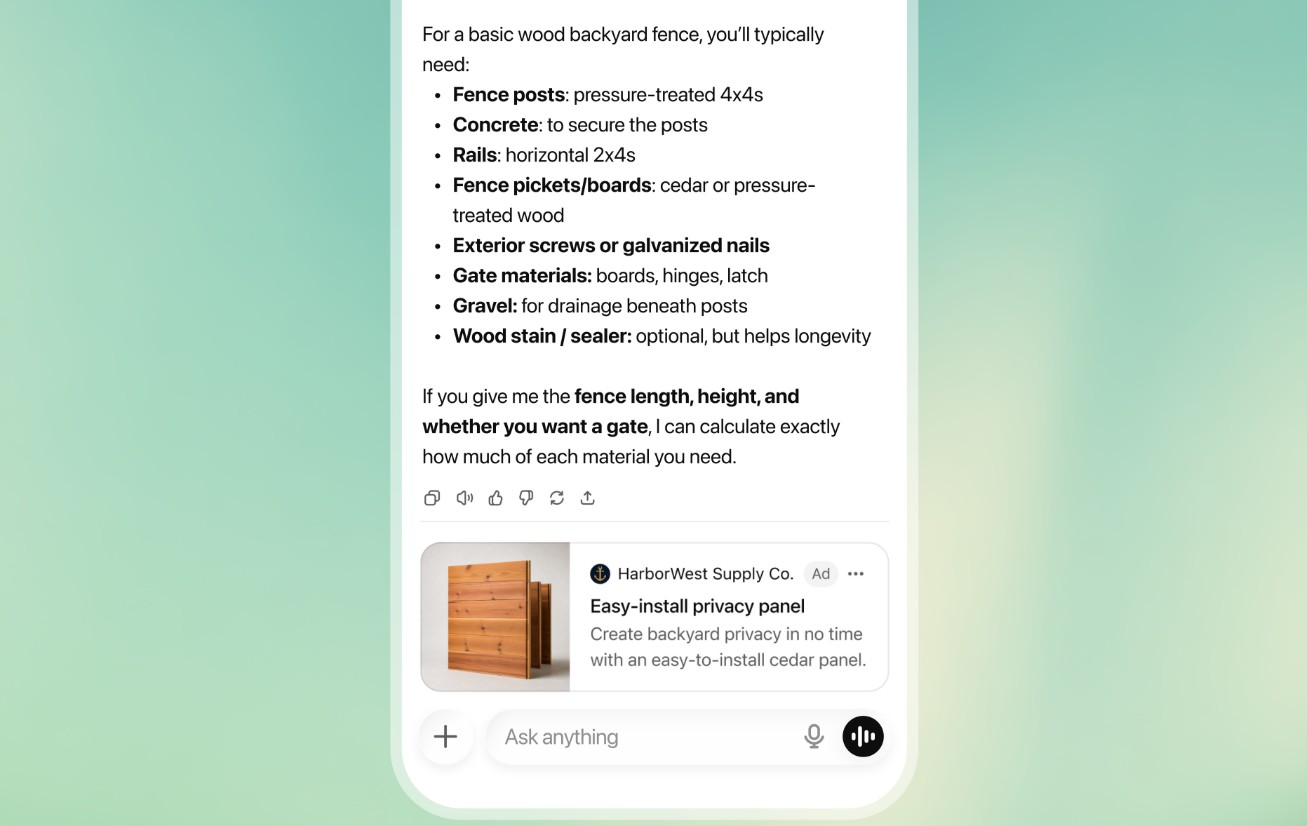
Ads appear below a ChatGPT response, never woven into the text of the answer. Each ad is clearly labelled and visually separated from the organic reply. OpenAI's Help Center specifies the ad's fields: advertiser name, favicon (logo), a title (headline), copy (description), a landing page, and an image asset. The governing design rule OpenAI states is that paid placements cannot change what ChatGPT says: the answer is determined by relevance and accuracy, not by who is spending.
How ads get matched (targeting)
Targeting is contextual rather than keyword- or profile-based, but it is broader than a single message. OpenAI's documentation says the system selects ads using the context and intent of the current conversation, the ad's own landing page, title and copy, advertiser-provided context hints, and when ads personalization is enabled, select signals from a user's broader ChatGPT experience. OpenAI said personalization was on by default with an opt-out at announcement, according to Axios. Context hints are the advertiser's main lever: at the ad-group level you describe the conversations, topics, or keywords where your product is relevant. Crucially, they are guidance, not exact-match keywords, and do not guarantee your ad shows in any specific conversation.
How you buy (pricing and the auction)
ChatGPT Ads supports two buying models. With the Reach objective you optimize for impressions and pay per 1,000 (CPM). With the Clicks objective you optimize for clicks and pay per valid click (CPC). You set a maximum bid at the ad-group level, and OpenAI recommends starting CPC campaigns with a maximum bid of roughly $3-$5 per click. Eligible ads are chosen through a relevance-weighted, second-price auction that OpenAI says aims to balance advertiser value and user value. (A note for accuracy: a "cost-per-engagement" model that appears in some third-party write-ups is not something OpenAI's docs describe, the models are CPM and CPC.)
How you measure it
Reporting in the Ads Manager beta covers impressions, clicks, spend, click-through rate, average CPC, average CPM, and conversions. To capture conversions, advertisers install OpenAI's measurement pixel for browser-side events and use the Conversions API for server-side events; a separate Advertiser API supports programmatic campaign creation, product feeds, campaign targeting, conversion-optimized campaigns, and custom audiences. You can also append UTM parameters to landing-page URLs to isolate ChatGPT traffic in your own analytics. The reporting available to advertisers is aggregated, advertisers do not receive individual conversations or the specific prompt that triggered an ad.
Who sees ads and who never does
OpenAI states it does not show ads to users on Plus, Pro, or any Business plan, nor to any account identified as belonging to someone under 18 (using account age information and age prediction where available). OpenAI says ads are excluded from sensitive contexts such as health, mental health, and politics. Free users can opt out of ads, but as GSMArena reported, doing so comes with a reduced free message limit.
How marketers can test it effectively
OpenAI's docs describe capabilities, not strategy. The practical playbook below comes from performance-marketing agencies actively working in the channel, useful, but directional and written by parties with a commercial interest in it. Much of it is drawn from breakdowns by Launchcodex and Parkour3.
- Pick the right category. Agency guidance points to research-heavy, high-consideration purchases, B2B software, financial services, travel, education, home services, where people describe detailed intent mid-conversation. Short-cycle, low-value e-commerce is a harder fit at current prices.
- Judge on cost-per-acquisition, not clicks. Early click-through rates have reportedly looked weak compared with Google Search because users keep talking after seeing an ad rather than clicking away. Evaluate on qualified leads or acquisitions, not CTR.
- Set up measurement before you spend. Install the pixel and Conversions API, add UTMs, and build a dedicated analytics segment first, because the platform's own reporting is aggregated by design.
- Write good context hints. Since hints (not keywords) drive matching, describe the real conversations where your product helps, and expect to iterate.
- Pair paid with organic AI visibility. A sponsored card sitting under an answer that never mentions your brand may be a weaker signal, and paid visibility disappears the moment the budget stops, so build organic presence (GEO/AEO) alongside, not instead.
- Treat the first 90 days as a learning budget. Agencies frame the early value as intelligence about how buyers describe their problems inside AI, more than immediate conversions.
If you want a team running this alongside your existing channels, our ChatGPT Ads agency service covers setup, measurement, and context-hint iteration end to end.
What early advertisers have reported
This is where the polished official picture meets lived reality, and the gap is the most important thing in this article. The limited reporting so far points to a recurring concern among first-wave advertisers: they have struggled to prove the ads worked. As eMarketer summarized reporting from The Information, some advertisers described the process as low-tech and said they still lacked data showing the ads had driven results; two agency executives said they had yet to prove measurable business outcomes.
The sub-complaints recurring in that reporting were:
- Clunky buying. Before self-serve expanded, buyers reportedly resorted to spreadsheets, emails, and phone calls to OpenAI reps.
- Shallow reporting for a premium price. Some advertisers reported receiving impressions and total clicks but not the query-level intent or conversion depth they use to justify spend.
- Under-delivery. One executive said a real problem was simply that ads were not shown often enough to gauge impact (a single voice, so weight it accordingly).
Reporting from eMarketer on the $100M revenue milestone captured the tension neatly: OpenAI said the pilot passed $100 million in annualized revenue within six weeks, even as some advertisers were still waiting for proof it performed. TechRadar framed the early risk as paying NFL-level rates for TV-style reporting.
What users have reported
On the other side of the screen, some users found in-chat commercial content intrusive, especially when it landed in an unrelated or paid context. The sharpest episode actually predated the formal ad launch: in late 2025 OpenAI tested "app suggestions" that surfaced brands like Peloton and Target mid-conversation. As Tom's Guide documented, paying subscribers reacted with cancel-threats, and TechCrunch reported OpenAI turned the suggestions off, with an executive conceding the company had fallen short. Notably, OpenAI said those suggestions had no financial component, yet users experienced them as advertising anyway. This is adjacent evidence, not direct evidence about the current ads product, but it is a telling signal about how little tolerance there may be for commercial content in the chat window.
Reported sentiment on the ads themselves included irritation, skepticism about the privacy promises, and a pragmatic minority accepting ads as the price of a free tool. A small, self-selected reader poll on PhoneArena (too small to be representative, read it only as shape, not magnitude) had its largest bloc saying they would move to an ad-free rival. Independent journalists testing the ads, cited by DeleteMe, described them as large, distracting, and often irrelevant.
The current drawbacks
- Early performance remains unproven. Several reported advertiser experiences offer no clear evidence the ads drive business outcomes at premium prices.
- Aggregated measurement. By design, advertisers cannot see the prompt that triggered an ad, demographic breakdowns, or placement-level detail.
- Privacy tension. Even if OpenAI does not sell the data, the system uses conversation context to choose ads, a tension privacy advocates keep flagging.
- Trust risk and insider dissent. A researcher's resignation, along with a former employee's New York Times op-ed, raised concerns that advertising incentives could gradually compromise user trust, captured in an implementation analysis by ALM Corp.
- Regulatory scrutiny. A US senator warned OpenAI that embedding ads in chatbot conversations could deceive users, exploit emotional attachment, and undermine privacy, the letter is linked in Resources.
- Limited addressable audience. Ads reach only Free and Go tiers; the large paid base never sees them, so total-user figures overstate real reach.
The bottom line
On paper, ChatGPT Ads presents a clean, privacy-conscious, contextually targeted product with familiar CPM/CPC buying and a real measurement stack. In practice, early reports are thinner than the brochure: several advertisers struggled to prove returns, reporting is deliberately aggregated, and some users have treated commercial content in chat as a reason to leave. It is genuinely early. For advertisers in research-heavy categories with strong attribution and an organic AI presence, a disciplined learning-budget test is defensible; for everyone else, directional advice from agencies is to watch and wait.
Resources
- OpenAI - Ads in ChatGPT: The Basics (Help Center) - official advertiser doc: format, targeting, pricing, auction, measurement
- OpenAI - Advertise in ChatGPT (Ads landing page) - product overview, workflow, trust principles
- OpenAI Developers - Ads (measurement pixel, Conversions API, Advertiser API) - technical/measurement documentation
- OpenAI - New ways to buy ChatGPT ads - CPC bidding, self-serve Ads Manager, partners
- OpenAI - A milestone in expanding access to AI with ChatGPT Ads - global expansion, SMB Ads Manager, feature set
- OpenAI - Testing ads in ChatGPT - rollout updates and country expansion
- U.S. Senator's letter to OpenAI on chatbot advertising (PDF) - primary regulatory/consumer-protection concerns