
TL;DR: From 27 September 2026, every online store selling goods to consumers in the EU must display a standardised, non-editable “Legal Guarantee Notice” before the consumer is bound by the order. The notice reminds shoppers of the legal-guarantee right, which is generally at least two years but may vary under national law; certain second-hand goods may be subject to an agreed shorter period of no less than one year. The notice cannot simply live in the Terms & Conditions. Offering a qualifying commercial durability guarantee remains voluntary for the producer, but once the producer offers it under the relevant conditions and makes the required information available, the trader must display the “GARAN” label. The 4% turnover figure is not the standard fine for every missing notice. It concerns the maximum penalties available for particular widespread infringements or widespread infringements with an EU dimension under the applicable enforcement framework. The regulation applies directly, with no transitional grace period.
What Regulation 2025/1960 is
Commission Implementing Regulation (EU) 2025/1960 was adopted on 25 September 2025, published in the Official Journal on 2 October 2025, and applies from 27 September 2026 in every Member State, with direct application and no transitional grace period. It does not change the substantive law of guarantees; it fixes the exact design and content of two new consumer-information tools.
The legal chain is simple: Directive 2011/83/EU on consumer rights gained a new Article 22a through Directive (EU) 2024/825 (“Empowering Consumers for the Green Transition”), and Regulation 2025/1960 “locks” the form of the two tools in its two annexes. In Greece, Directive 2024/825 was transposed by Law 5317/2026 (Government Gazette, 10 July 2026).
The two tools at a glance
- Legal Guarantee Notice: Mandatory. Operates at shop level (not per product). Reminds consumers of the legal guarantee owed by the seller, which is generally at least two years but may be longer under national law; for certain second-hand goods, national law may permit an agreed shorter period of no less than one year. No element of the notice may be modified.
- GARAN label: Mandatory for qualifying products. The producer’s decision to offer a commercial durability guarantee is voluntary. Where the producer offers it free of charge, it covers the whole product for more than two years, and the producer makes the required information available, the trader must display the GARAN label for that product.
Legal vs commercial guarantee: the distinction to get right
The legal guarantee of conformity is a statutory consumer right, owed by the seller and independent of any producer promise. The commercial durability guarantee is an extra, voluntary commitment by the producer. When it meets the GARAN conditions and the producer makes the required information available, displaying the label is mandatory for the trader. The commercial guarantee never replaces, limits, or removes the legal guarantee, and the notice exists, in part, precisely to stop the opposite being implied.
What it means for the consumer
The notice reminds consumers that goods sold in the EU are covered by a legal guarantee that is generally at least two years, at no extra cost. National law may provide a longer period and may permit an agreed shorter period of no less than one year for certain second-hand goods. A consumer can invoke their rights when, for example, the product does not match its description or does not work as intended.
In such cases the seller may be required, depending on the circumstances, to offer free repair or replacement and, in certain cases, a price reduction or full refund. The notice also gives two practical steps: contact the seller as soon as possible, and keep the proof of purchase (receipt, invoice, or bank-statement extract). A QR code leads to the national section of the “Your Europe” portal for fuller information.
Sanctions for non-compliance
Regulation 2025/1960 itself provides no penalties. It consists of just three articles and two annexes. Sanctions come from the national framework: Directive 2024/825 plugs into the existing consumer-protection enforcement system (via the Omnibus Directive 2019/2161), which in Greece is implemented through Article 13a of Law 2251/1994. The 4% turnover figure does not apply automatically to every missing notice. It concerns the maximum fine available when sanctions are imposed for widespread infringements or widespread infringements with an EU dimension under Article 21 of Regulation (EU) 2017/2394.
The authority now responsible for inspections and sanctions is the Independent Authority for Market Control and Consumer Protection (Law 5255/2025), which is already imposing significant administrative fines. In addition, a summary of every fining decision (name, registered seat, breach, amount) must be published on the authority’s website within three working days, which adds a public-exposure dimension to the financial consequences.
Summary table of sanctions
| Violation / Case | Sanction | Range / Ceiling |
|---|---|---|
| General breach of consumer-protection provisions (Art. 13a, Law 2251/1994) | Compliance recommendation and/or administrative fine | €5,000 to €1,500,000 |
| Repeated breaches within five years (more than one fining decision against the same trader) | Higher maximum fine | up to €3,000,000 |
| Widespread infringement or widespread infringement with an EU dimension (Art. 21, Reg. (EU) 2017/2394) | Maximum fine available under Art. 13a(2b) | at least 4% of annual turnover in the relevant Member State(s); €5,000,000 where turnover information is unavailable |
| Failure to reply to consumer complaints or provide requested documents | Compliance recommendation and/or administrative fine | €2,000 to €50,000 |
Note: the amounts reflect Article 13a of Law 2251/1994 as amended by Law 4933/2022. Enforcement weighs the nature, gravity, extent and duration of the breach, any remedial action, and prior breaches.
How to design it into your e-shop
The notice is pre-contractual information: it must be given to the consumer “in a conspicuous manner, before they are bound by the contract”. That is the whole legal test; the Regulation defines what the notice looks like, not which page it sits on. So the answer to “where” is: anywhere that satisfies “prominent, and seen before the order is completed.”
Beware the most common mistake: placing the notice only in the Terms & Conditions is not compliance. The same goes for the footer or a help page nobody opens. The notice is meant to be seen by someone who is buying, not filed where it won’t be read. You may also reference it in the Terms & Conditions, but that cannot be the only place.
You don’t design these artefacts: you download and place them
Before any specification, the single most important point: you are not supposed to design the notice or the GARAN label from scratch. The European Commission publishes the official artwork as ready-made vector files (SVG / PNG / JPG) in every EU language. The correct workflow is to download the official file and place it. For the notice, that is the whole job: no element of it may be modified, so you use it exactly as issued. For GARAN, you fill in only three editable fields (duration in years, producer brand/trademark, model identifier); the producer normally supplies those values. You are editing a template, not rebuilding a graphic. A home-made look-alike is actually non-compliant, because nothing other than those three GARAN fields may be altered.
A note on GARAN before the specs, so you don’t chase requirements you don’t need: offering the qualifying guarantee is voluntary, but displaying GARAN is not. The label applies per product where a producer offers, free of charge, a durability guarantee covering the whole product for more than two years and makes the required information available; in that case the trader must display the GARAN label. If none of your products has such a guarantee, you handle only the mandatory notice, and the GARAN-specific table below does not apply to you.
With that framing, the specifications split cleanly into two groups. The first are display rules, covering colour, font, and the RGB/link behaviour, and they govern how both artefacts appear on screen. The second are GARAN-only specifications, covering the editable fields and the label’s reference dimensions, and they matter only if you actually display a GARAN label.
Display rules (apply to both the notice and GARAN)
| Display rule (notice + GARAN) | Requirement |
|---|---|
| Colour (online) | Must be shown in colour (RGB) when the contract is concluded through an online interface |
| Blue | Pantone Reflex Blue C · RGB 0/51/153 · HEX #003399 |
| Yellow | Pantone Yellow C · RGB 255/237/0 · HEX #FFED00 |
| Black | Pantone Black 6 C · RGB 0/0/0 · HEX #000000 |
| White | Pantone 000C · RGB 255/255/255 · HEX #FFFFFF |
| Font | Inter (Regular, SemiBold, ExtraBold) |
| Link (online) | A clickable link with the same destination as the QR code is required: a QR cannot be scanned on the device the shopper is already using |
| Notice QR target | The national section of the “Your Europe” portal (europa.eu/youreurope/guarantees) |
| GARAN QR target | europa.eu/youreurope/commercial-guarantee-durability/index.htm |
Note: the Official Journal prints the yellow as “#FFEDOO” (with the letter O); the correct value is #FFED00, consistent with the CMYK Y:100 and RGB 255/237/0 given alongside.
GARAN-only specifications (skip this table entirely if you display no GARAN label)
| GARAN-only (when applicable) | Requirement |
|---|---|
| The 3 editable fields | Duration in years · producer brand/trademark · model identifier. Nothing else on the label may be changed. |
| Who supplies the values | The producer. The trader fills the values into the official template, not by re-drawing the graphic |
| Reference size (off-line) | Minimum 95 × 100 mm · translations 7 pt · brand/model fields 9 pt · years numeral “XX” 80 pt (these are baked into the official file; scale proportionally) |
| Nested (compact) form online | Allowed; the full label must appear on the first action (click / hover / touch-expand), before the order is placed |
Below are the placement options, from the lightest to the strongest. A prudent pattern for an e-shop is a prominent shop-level entry point (a link/element in the header), the full notice shown at checkout before submission, and inclusion of the notice and any applicable GARAN label in the order-confirmation email in line with the Commission’s practical guidelines.
Homepage / Site header
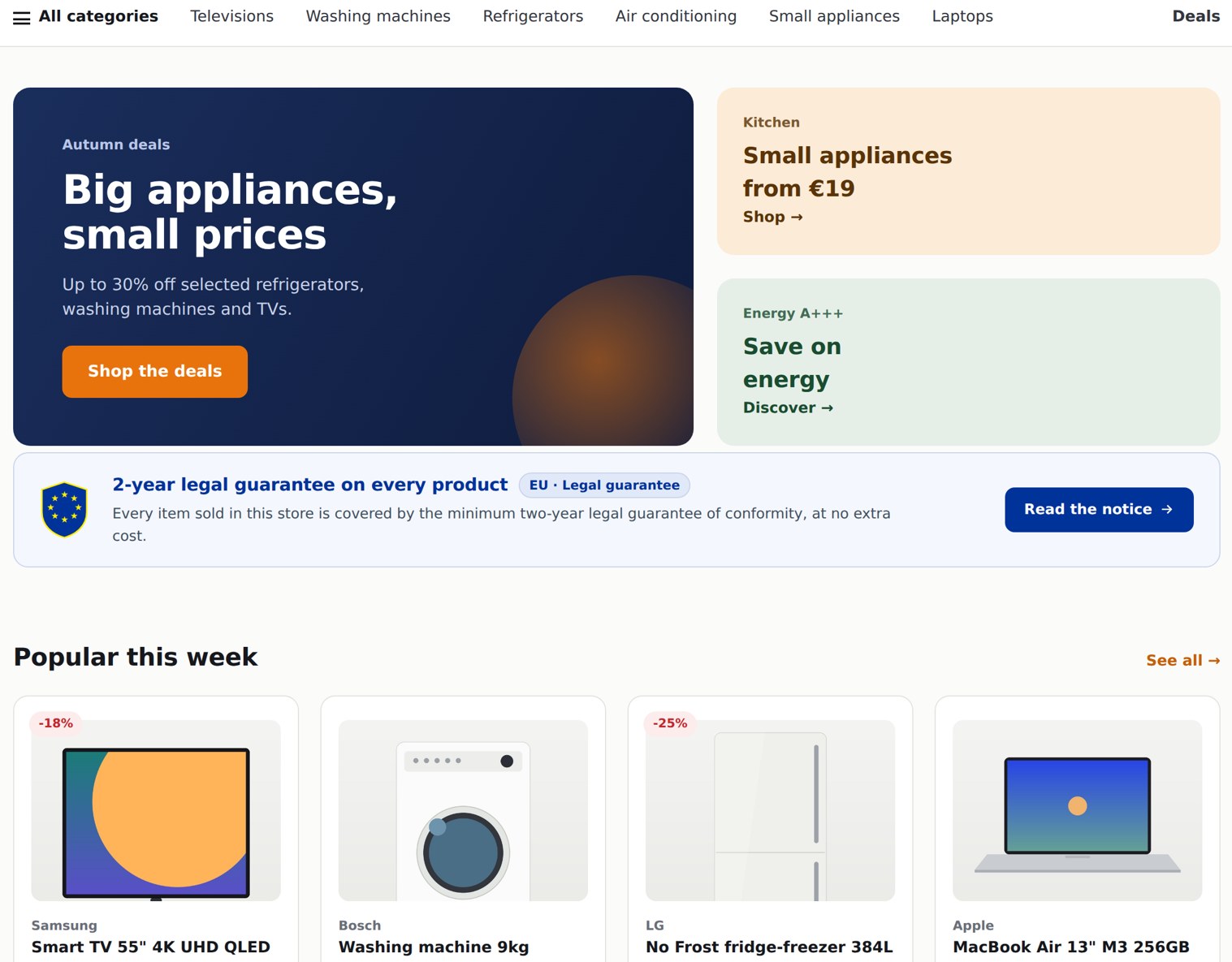
Acceptable. Because the notice operates at shop level (the same right applies to everything you sell), a fixed, visible entry point, such as a header link or a standing element, can “cover” the whole store. It is efficient, but on its own it sits at the “minimum” end: it works best as a permanent, always-available access point combined with a stronger placement further down.
Product gallery / Catalogue page
Acceptable as one of the expressly named placements. It need not appear on every product tile; it is enough that it is conspicuously reachable from the collection/catalogue page. A useful spot for stores with heavy traffic landing straight on categories.
Product page
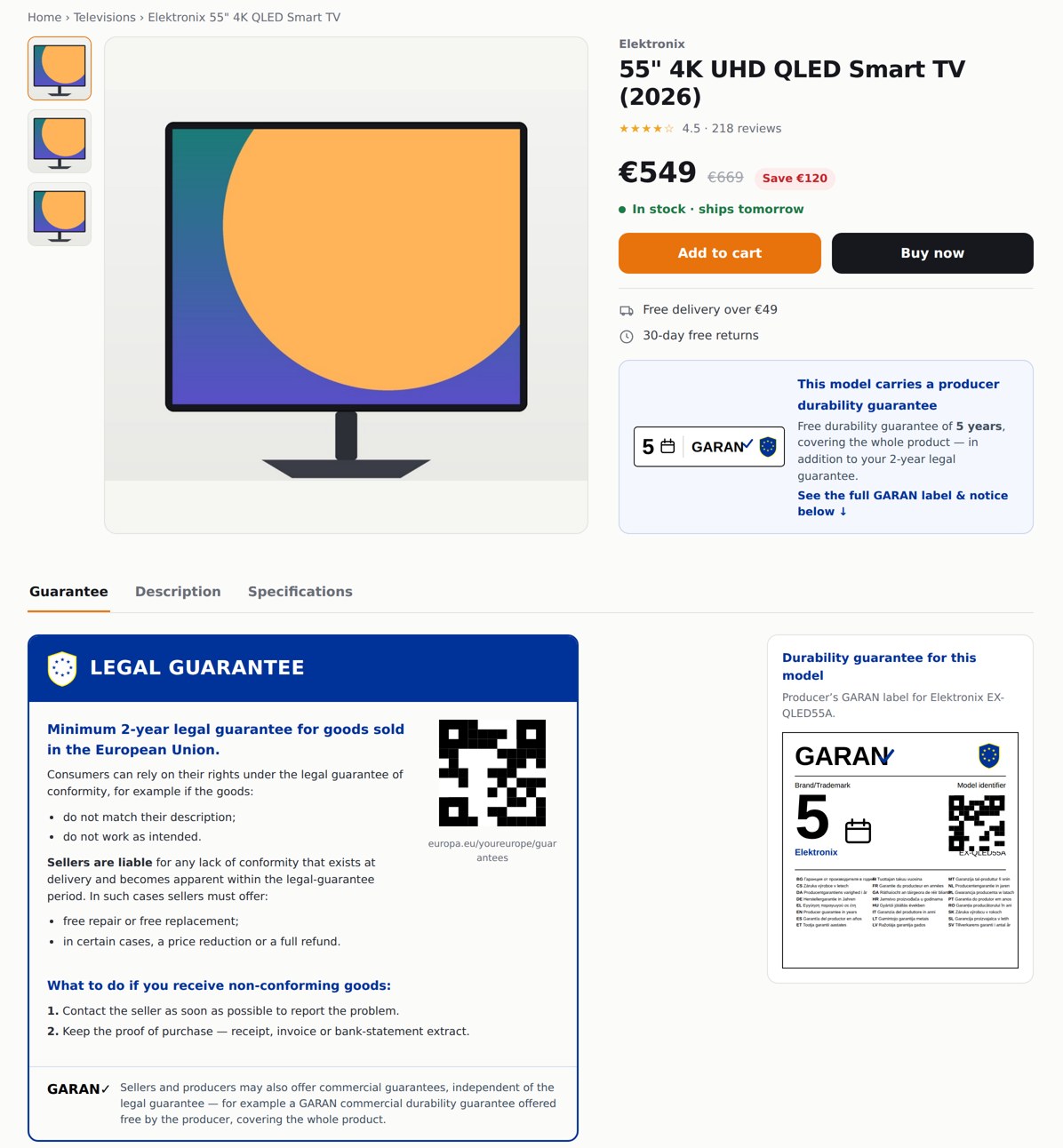
A good and common home for it (for example, as a tab or panel near the product details), where anyone comparing products will look. It is also the natural home of the GARAN label: GARAN is per-product and is placed next to the specific model it covers. It must never imply products without such a guarantee are covered.
Cart / Checkout page
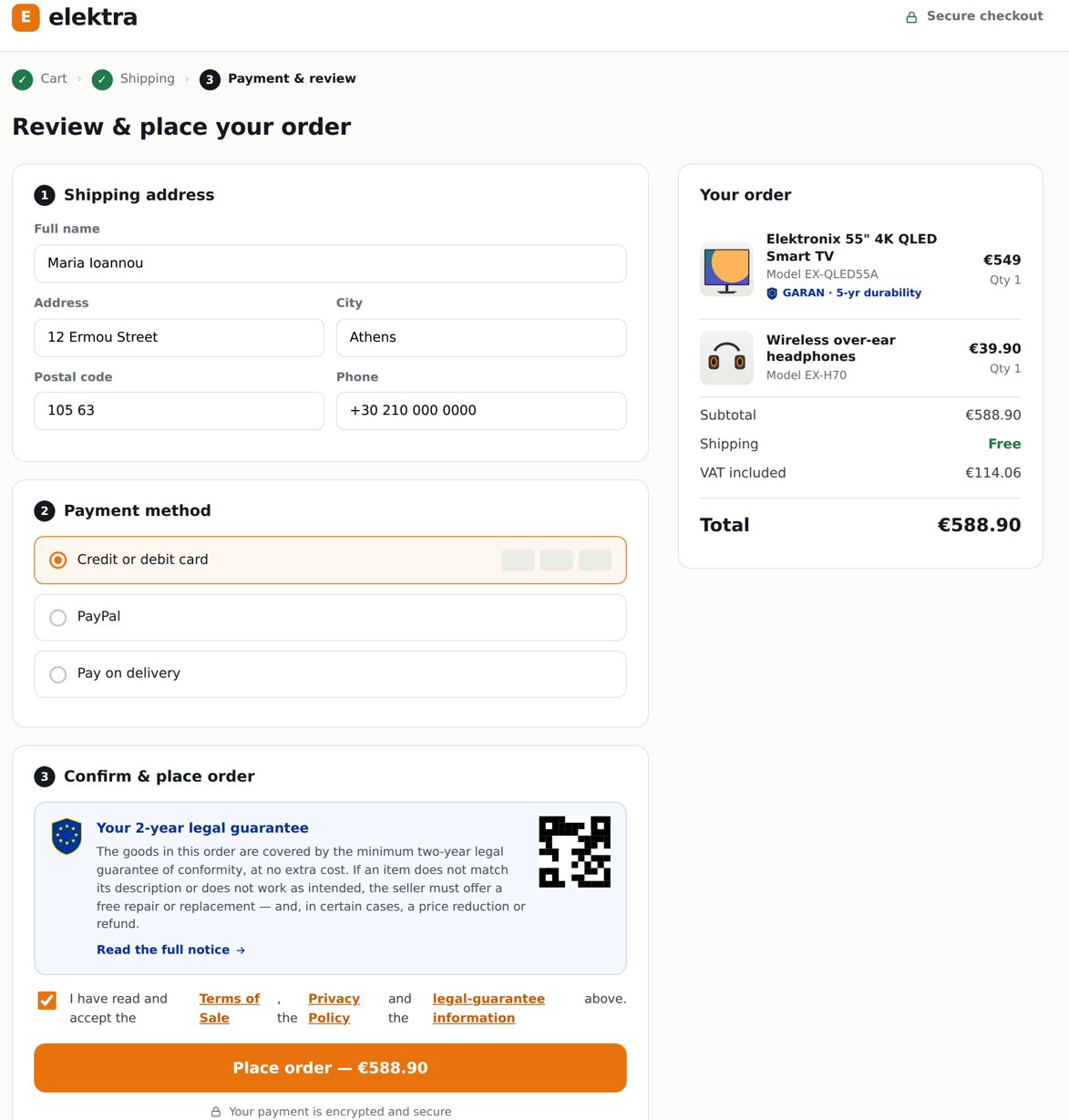
The strongest position, because this is the moment “before the consumer is bound.” It is typically placed near the terms-acceptance checkbox or the place-order button. If you must pick a single spot, this is the safest because it makes compliance with the pre-contractual test indisputable.
Order-confirmation email
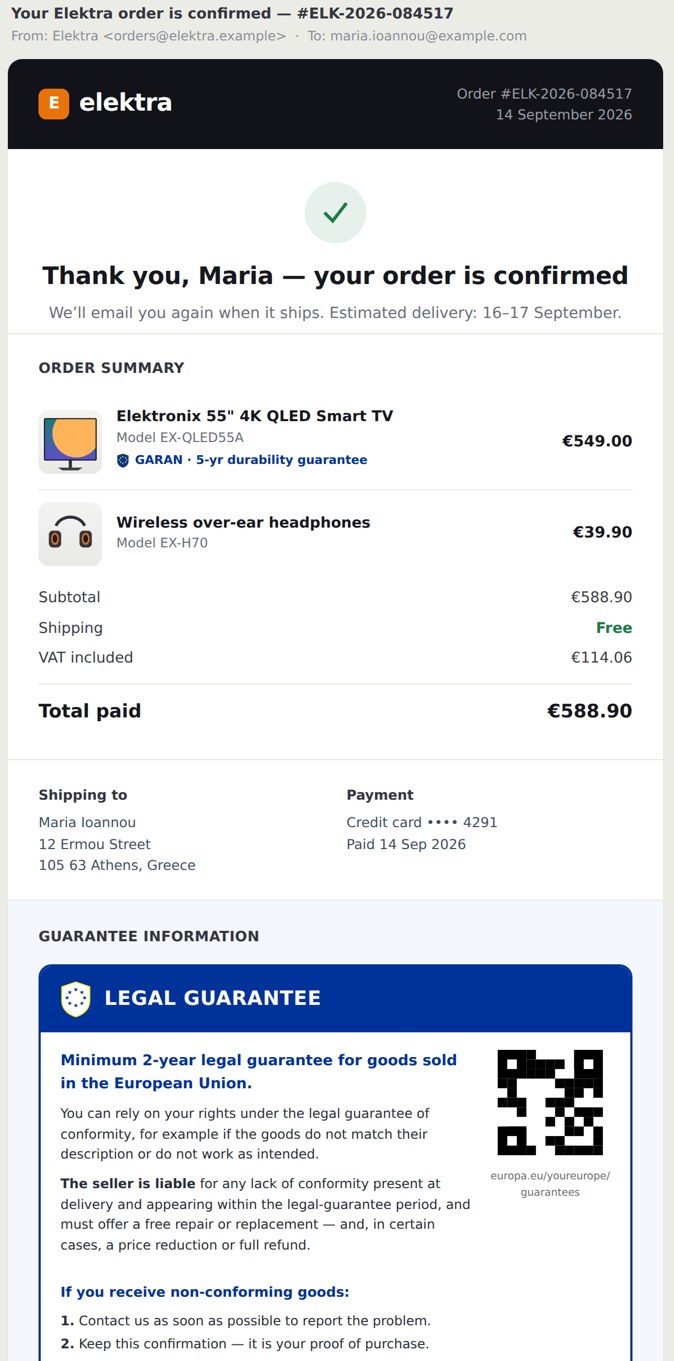
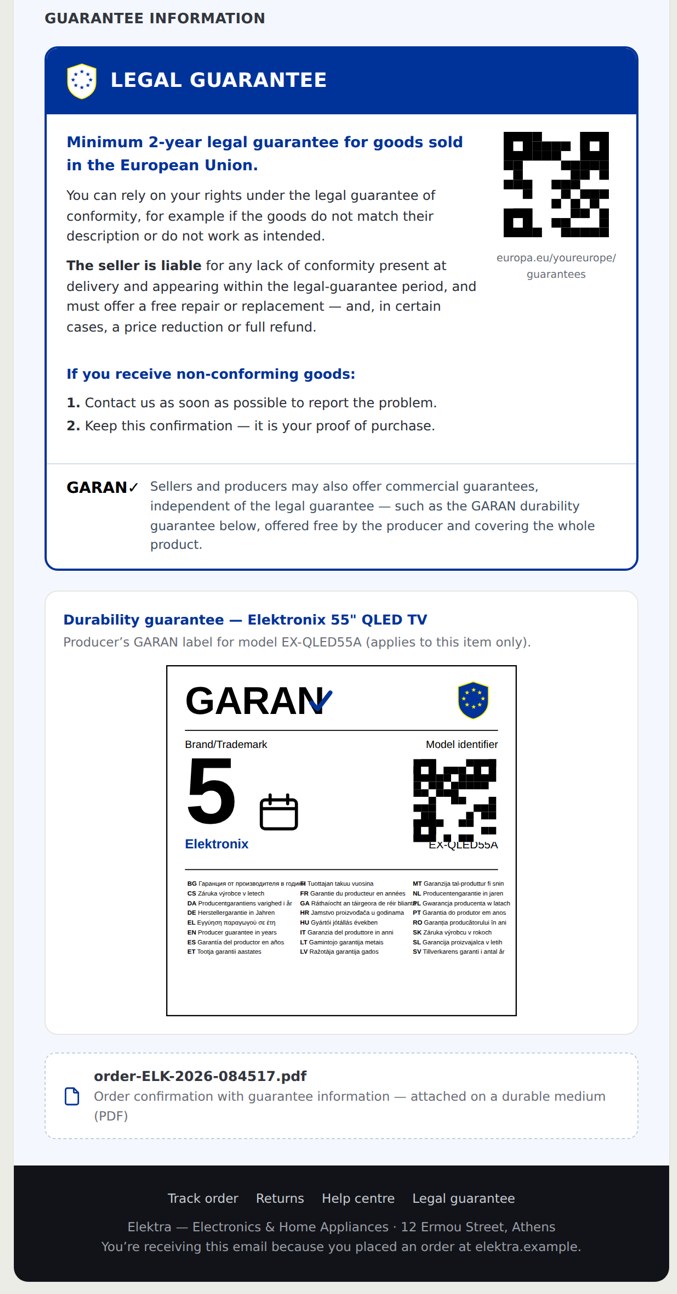
A strong compliance measure. Article 8(7) of Directive 2011/83/EU separately requires confirmation of distance contracts on a durable medium and the inclusion of specified pre-contract information unless it has already been provided on a durable medium. The Commission’s practical guidelines state that the notice and any applicable GARAN label should also be included in the order-confirmation email, embedded or attached. The guidelines explain that they express preliminary views of the Commission’s services and do not constitute an authoritative interpretation of EU law. Email inclusion should therefore be treated as a strong compliance measure, not as an absolute additional requirement created by the guidelines.
And GARAN? Everything above concerns the mandatory shop-level notice. GARAN is per product. The producer’s decision to offer a qualifying commercial durability guarantee is voluntary, but once the relevant conditions are met and the producer makes the required information available, the trader must display the label for that product. It belongs on the relevant product page, and the Commission’s practical guidelines recommend including it in the confirmation email for that product. If none of your products is covered by a qualifying guarantee, you display no GARAN label at all; you display only the notice.
Compliance checklist
- The notice appears conspicuously before the order is completed (ideally at checkout).
- There is a permanent, visible access point at shop level (header/page).
- The notice and any applicable GARAN label are included in the order-confirmation email, as recommended by the Commission’s practical guidelines.
- Online it is shown in colour (RGB), legible, with a clickable link to the same destination as the QR.
- It is not located only in the Terms & Conditions / footer.
- The GARAN label (if applicable) is placed per product, with the 3 editable fields filled in correctly.
- The artefacts render without distortion, on both desktop and mobile.
If you would rather have this implemented and tested on your own store, our teams work on exactly this kind of change through eCommerce development and web and app development.
Resources
- Commission Implementing Regulation (EU) 2025/1960: EUR-Lex
- Directive (EU) 2024/825 (Empowering Consumers): EUR-Lex
- Consumer Rights Directive: European Commission
- Summary of Regulation 2025/1960: Bureau Veritas
- FAQ on the Notice & GARAN Label: Bird & Bird (Lexology)
- EU Guarantee Notice & GARAN Label: HKTDC Research
- Online display & QR: qr3.app
- EU Guarantee Notice for Magento 2: mdsoft
- Article 13a of Law 2251/1994 (Sanctions): opengov / Ministry of Development
- Independent Authority for Market Control & Consumer Protection (Law 5255/2025): Taxheaven
- New mandatory legal-guarantee information: GRECA
- Native GARAN support: Shopware
- EU Legal Guarantee Notice and GARAN Label: Your Europe
- Practical Guidelines on the Harmonised Notice and GARAN Label: European Commission
- Law 4933/2022 Article 23 on Article 13a sanctions: Taxheaven